

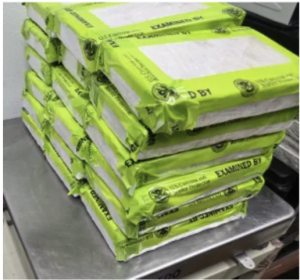
On Tuesday, December 2, CBP officers at the Rio Grande City International Bridge cargo facility stopped a Kenworth tractor attempting to cross from Mexico. During secondary inspection, officers discovered cocaine concealed inside.
The seizure: nearly 42 pounds of cocaine worth $549,275.
But this single seizure is just one piece of a much larger pattern. In recent weeks alone, Rio Grande City has seen seizures of:
- $3 million in cocaine (one enforcement action)
- $956,000 in cocaine (single weekend seizure)
- $888,000 in cocaine (single week seizure)
- $549,275 in cocaine (42 pounds hidden in a tractor)
- $424,000 in cocaine (hidden in vehicle)
In just a few weeks, Rio Grande City CBP officers have seized nearly $6 million in cocaine. The volume is staggering. The smuggling is relentless.
How They Found It
CBP officers utilized nonintrusive inspection technology to detect anomalies in the Kenworth tractor. The X-ray scan revealed suspicious concealment. Officers conducted a physical inspection and discovered the cocaine.
Nearly 42 pounds of pure cocaine. Hidden in a commercial truck. Headed into America.
The Pattern at Rio Grande City
Rio Grande City sits directly across from Ciudad Camargo, Mexico. It’s one of the busiest commercial crossing points on the Texas border. And it’s become a major cocaine trafficking corridor.
The seizures aren’t random. They’re systematic. Officers are catching big shipments because the volume of smuggling is enormous. For every $549,000 seizure, multiple smaller shipments probably get through.
Why Tractors?
Commercial trucks crossing at Rio Grande City carry legitimate cargo—produce, parts, goods. Smugglers use these trucks because:
- They’re expected
- They cross frequently
- Inspections are fast to keep commerce flowing
- Hidden compartments can hold significant quantities
- The sheer volume makes detection difficult
By mixing cocaine with legitimate cargo, smugglers are betting on speed and volume. Most trucks get waved through. Some get inspected. And when inspectors find drugs, they seize them.
The Bigger Picture
Rio Grande City isn’t unique. Every major Texas port is seeing massive cocaine seizures. Just last week:
- Del Rio seized $498,000 in cocaine
- Laredo seized multiple large shipments
- Brownsville seized over $70,000 in currency (likely cartel proceeds)
- El Paso seized firearms destined for Mexico
The Texas border is a war zone. Not literally. But the volume of drugs, weapons, and money moving across it represents an unprecedented trafficking operation.
What This Cocaine Represents
Nearly 42 pounds of cocaine represents:
- Cartel production capacity
- Sophisticated smuggling networks
- Billions in annual trafficking revenue
- Addiction and overdose deaths in American communities
- Violence and destabilization in source countries
Every pound that makes it through the border contributes to America’s cocaine epidemic. Every pound that gets seized is a pound that won’t destroy lives.
The Cost of Interdiction
CBP officers are doing their job. They’re catching drugs. They’re making seizures. But the resources required are massive. Every seizure requires:
- Officers’ time and attention
- Technology deployment
- Secondary inspection processes
- Investigation and prosecution
- Storage and destruction of seized drugs
And despite all this effort, the flow continues. Cartels have unlimited supply. Cartels have unlimited money. Cartels have unlimited patience.
For every $549,000 seizure, there’s probably $5 million more that gets through at other ports or crossing points.
The Bottom Line
CBP officers at Rio Grande City seized nearly 42 pounds of cocaine worth $549,275 hidden in a commercial tractor on December 2. It’s one of several major cocaine seizures at that port in recent weeks.
The cocaine wasn’t heading to a warehouse. It was heading to American streets. To dealers. To addicts. To communities already devastated by cocaine and fentanyl.
That officers caught this shipment is good. That cartel networks are sending so many shipments is bad. It means production is massive. Supply is unlimited. And the fight to stop it is far from over.