

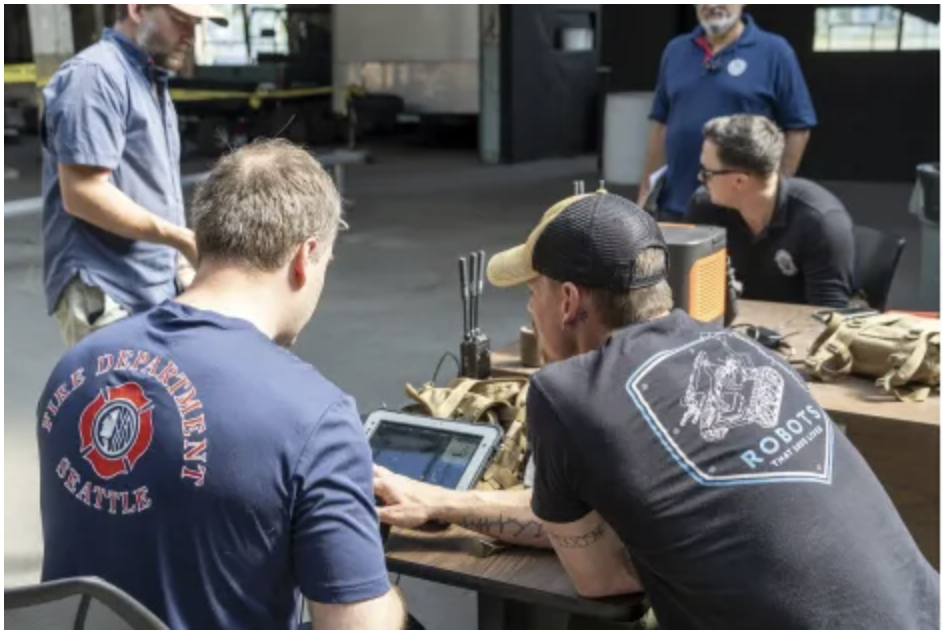
In August 2025, the Department of Homeland Security put three different robot systems through their paces in real-world emergency scenarios. What they found: unmanned ground vehicles (UGVs)—robots with wheels, cameras, and robotic arms—are ready to change how first responders handle the most dangerous situations.
Now these robots are heading to emergency departments across America. Texas could be next.
What These Robots Actually Do
Think of them as remote-controlled vehicles with a camera, sensors, and a robotic arm. They can navigate rubble. They can climb stairs. They can open doors. They can pick up objects. Most importantly, they keep human responders out of the most dangerous situations.
The three systems tested were:
- Boston Dynamics SPOT (looks like a four-legged dog, extremely maneuverable)
- Teledyne FLIR Packbot 525 (tank-like tracked vehicle, tough terrain capability)
- Ghost Robotics Vision 60 (six-legged system, exceptional climbing ability)
Each one has different strengths. But they all do one thing: they let responders see what’s happening without putting people in immediate danger.
Scenario 1: Chemical Spill (HAZMAT)
Imagine a warehouse chemical spill. Toxic fumes. Unknown substances. Responders can’t just walk in.
In the DHS test, responders used handheld controllers to send the UGVs into a simulated HAZMAT incident. The robots navigated around barrels of hazardous materials, captured video, took sensor readings, and moved objects—all remotely.
“These technologies can be equipped with sensors that can identify hazardous chemicals and relay critical data back to teams positioned at safe remote distances,” said Tyler Mackanin, NUSTL Test Lead.
For Texas refineries, chemical plants, and industrial facilities, this changes everything. A HAZMAT team can deploy a robot first. Get readings. Assess the danger. Plan the response. All without exposing people to toxic exposure.
Scenario 2: Building Collapse (Search and Rescue)
After a disaster—an earthquake, building collapse, explosion—rescuers need to search rubble for survivors. But that rubble is unstable. It might collapse again. People can get trapped.
The DHS test set up a rubble pile with mock victims (manikins) hidden in tight spaces. The UGVs navigated through concrete, metal, gravel, and debris at various angles. They found victims. They transmitted live video. They moved objects with their robotic arms.
“UGVs can reach areas inaccessible or potentially harmful to human rescuers, allowing teams to scout for hazards and safe entry points,” Mackanin explained.
For Texas, this matters in Dallas, Houston, and Austin where older buildings could collapse in severe weather or earthquakes. Urban search and rescue teams could deploy these robots into unstable structures, find people, and plan safe rescue routes before sending human rescuers in.
Scenario 3: Medical Emergency (EMS)
When someone collapses in a building with stairs, obstacles, and confined spaces, every second counts. EMS needs to find the victim fast.
The DHS test sent UGVs into a multi-story building to locate mock victims. The robots climbed stairs. They navigated confined spaces. They found people. They communicated conditions back to operators outside.
For Texas EMS and fire departments, this means deploying a robot into a building fire or a medical emergency scene to scout for victims before sending firefighters into smoke and heat.
The Technology That Makes This Work
These aren’t toys. They’re sophisticated systems:
Cameras and Sensors: Real-time video, thermal imaging, chemical detection—operators see exactly what the robot sees.
Robotic Arms: Can open doors, pick up objects, assess conditions. The Boston Dynamics SPOT has arm strength that surprised responders.
Terrain Capability: The robots tested could handle stairs, rubble, slopes, and confined spaces. Not all robots can do all of this.
Battery Life: Critical for extended operations. Responders specifically requested quick-charging, swappable batteries.
Range and Communication: The robots need to maintain connection over distance and be compatible with different communication networks.
User Interface: Handheld controllers or tablet-based interfaces. Responders need intuitive controls they can learn quickly.
Why Texas Should Care
Texas has significant urban areas where building collapses could trap people. Texas has chemical plants and refineries where HAZMAT incidents are real. Texas has disaster scenarios—hurricanes, tornadoes, floods—where search and rescue is critical.
These UGVs could:
- Reduce responder injuries in hazardous situations
- Speed up victim location and rescue
- Give incident commanders real-time data before deploying teams
- Handle chemical, biological, and radiological threats
- Navigate unstable structures and debris fields
For Dallas Fire-Rescue, Houston Fire Department, Austin Fire, and departments across Texas, these robots represent a massive upgrade in capability.
What Happens Next
DHS conducted this assessment through its SAVER program (System Assessment and Validation for Emergency Responders). They tested three systems. They gathered data from responders across six states.
Soon, DHS will release the full assessment results. Fire departments, police departments, and emergency management agencies across Texas will see the data. They’ll decide whether to purchase these systems.
The cost varies. Boston Dynamics SPOT runs around $150,000. Packbot systems are similar. For a major Texas city fire department, budget for $300,000-$500,000 to buy robots and training.
For that investment, cities get response capability they didn’t have before.
The First Responder Perspective
What did responders actually say after testing these robots? They liked them. Specifically, they requested:
- Manipulator arms for opening doors and handling objects (systems delivered)
- Adaptable communications for different radio networks (systems have this)
- Quick-swap batteries for continuous operation (systems offer this)
- Ability to climb stairs (some systems can, some struggle)
- Strong, reliable control interfaces (feedback mixed but improving)
“This assessment of UGVs is a direct result of input from emergency responders from a diverse set of agencies and missions,” Mackanin said. “It was important to assess these evolving systems in various operational scenarios to gauge how they would perform.”
This wasn’t theoretical. This was real first responders testing real systems against real-world scenarios.
The Real-World Impact
Imagine this scenario: A building collapse in Dallas traps people in rubble. Rescuers deploy a Boston Dynamics SPOT. The robot climbs into tight spaces humans can’t safely access. It finds a victim. It transmits video and location data. Rescue teams now know exactly where to dig and how to approach safely.
That victim gets rescued faster. Rescuers stay safer. The outcome improves.
That’s not science fiction. That’s what happened in the DHS test. That’s what’s coming to Texas emergency response.
The Bottom Line
DHS tested three unmanned ground vehicle systems in real emergency scenarios. Responders loved them. The systems work. They’re commercially available. And departments across Texas are about to start buying them.
This is the future of emergency response: robots going into danger first, gathering data, keeping people safe, and enabling faster, smarter rescue operations.
Texas first responders are ready. The technology is ready. It’s just a matter of departments deciding to invest.
When they do, lives will be saved.
The Three Systems Tested:
Boston Dynamics SPOT
- Four-legged design
- Exceptional maneuverability
- Climbs stairs effectively
- Robotic arm capability
- ~$150,000
Teledyne FLIR Packbot 525
- Tracked vehicle design
- Tough terrain capability
- Manipulator arm
- Proven HAZMAT capability
- Similar price range
Ghost Robotics Vision 60
- Six-legged system
- Exceptional climbing ability
- Door-opening capability
- Advanced terrain navigation
- Similar price range
Evaluation Categories:
- Capability (sensors, arms, terrain handling)
- Usability (controls, interfaces, training)
- Deployability (portability, battery life, range)
Timeline: Assessment results coming soon from DHS SAVER program