

The federal government just awarded $3.3 billion in contracts for Smart Wall construction in Texas and Arizona. By itself, that’s a big number. But understanding what a Smart Wall actually does—and why it matters for Texas safety—tells the real story.
This isn’t just about building a bigger fence. This is about fundamentally changing how Border Patrol detects, tracks, and stops illegal activity before it happens.
What a Smart Wall Actually Is
Forget everything you think you know about border walls. A Smart Wall isn’t just steel and concrete sitting there looking tough.
A Smart Wall is a layered security system combining:
Physical barriers: Steel bollard walls, waterborne barriers (floating buoys linked together), secondary walls. Multiple layers creating actual impedance—making it harder to cross illegally.
Detection technology: Ground sensors that detect human movement and can distinguish between a person and an animal. Laser-based lidar sensors capturing 3D images of people from a distance. Linear ground detection creating an invisible trip wire along the border.
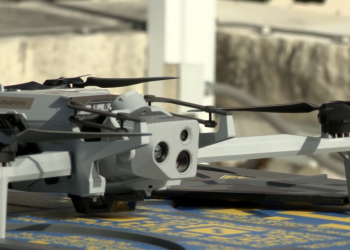
Cameras: Day and night vision cameras with artificial intelligence that can identify specific threats, use facial recognition, and track movement in real-time.
Lighting: Strategic illumination creating visibility while making concealment harder.
Roads: Patrol roads allowing Border Patrol agents rapid access to areas where threats are detected.
Real-time command centers: All of this data flowing into a unified command system where agents see what’s happening across the entire border in real-time.
It’s not one thing. It’s everything working together simultaneously.
How the Technology Actually Works
Here’s where it gets smart:
A ground sensor detects movement at the border. Instead of a human staring at a monitor trying to figure out what triggered the alarm, the system automatically activates cameras at that specific location. The AI analyzes the images in milliseconds, determining if it’s a person, a group of people, an ATV, a pickup truck, or a heavy truck.
Facial recognition can identify specific persons of interest. The system learns over time, getting better at distinguishing real threats from false alarms (wind, animals, foliage moving).
Once the system confirms a threat, it automatically alerts Border Patrol agents and presents them with real-time video, location data, and direction of movement. Agents now know exactly where to deploy and what they’re responding to before they even arrive.
This is domain awareness. The ability to see what’s happening across the entire border in real-time—not just in the visual spectrum, but in thermal, infrared, and sensor data simultaneously.
“When you have domain awareness with the fusion of critical intelligence, then you have a machine gathering all of this stuff in relation to time and presenting a picture to you that is a real-time understanding of what is going on at the border,” explains Chuck DeVore, chief national initiatives officer for the Texas Public Policy Foundation. “That allows you to deploy your limited assets so now you can move to meet the threat.”
That’s the game-changer. Border Patrol agents aren’t waiting to see illegal activity. They’re seeing it coming and deploying to stop it.
What Texas Gets Specifically
Five new contracts totaling $3.3 billion (which brings total awarded contracts to $8 billion) will add:
97 miles of primary border wall system along the Texas and Arizona border.
19 miles of secondary border wall (double-layer protection).
66 miles of waterborne barrier system along river sections where smugglers typically exploit gaps.
Approximately 149 miles of detection technology in locations where barriers already exist but the Smart Wall system isn’t complete.
In Texas specifically:
Del Rio 3 Project ($372.8 million): 22 miles of primary wall and 13 miles of detection technology in the Del Rio Sector.
Laredo 1 Project ($440.4 million): 15 miles of primary wall and 16 miles of waterborne barrier in the Laredo Sector.
Laredo 2 Project ($964.8 million total): 41 miles of primary wall and 50 miles of waterborne barrier in the Laredo Sector.
These aren’t theoretical miles. These are specific locations along the Texas border where smuggling operations, human trafficking, and narcotics trafficking are most active.
Why This Actually Improves Safety for US Citizens
The direct answer: it stops illegal activity before it reaches American communities.
Drugs don’t have to cross the border and make it inland before being stopped. The Smart Wall detects them at the crossing point. Human trafficking victims don’t have to be transported across Texas before rescue. Criminals don’t have to successfully cross and disappear into the country.
Early detection means early interdiction. Early interdiction means criminals get caught at the border instead of operating inland.
For Texas communities, that means:
Fewer drugs on streets. Fentanyl, methamphetamine, cocaine—all detected and stopped at the border instead of reaching Texas cities.
Reduced human trafficking. Victims rescued at the border instead of trafficked through Texas.
Reduced criminal activity inland. Gang members, cartel operatives, and organized crime figures caught before they establish operations in Texas communities.
Better resource deployment. Border Patrol agents deployed to actual threats instead than wasting time investigating false alarms or responding reactively.
Transnational Criminal Organizations exploit gaps along the border. A Smart Wall eliminates those gaps. No gaps means fewer smuggling routes. Fewer routes means less illegal activity reaching American communities.
The Numbers on What This Prevents
In fiscal year 2024, Border Patrol seized an average of $152,418 in unreported currency every single day along the U.S. border. That’s $55.6 billion annually in seized narcotics, cash, and contraband.
A more effective Smart Wall system catches more of it faster.
The current system catches some. A fully deployed Smart Wall catches more. More interceptions mean more criminals prosecuted, more drugs stopped, more victims rescued.
Why the Technology Matters
Physical barriers alone can be defeated. Barriers with sensors alone can be circumvented. But barriers plus sensors plus cameras plus AI plus real-time command centers plus agent deployment—that’s a system designed to be comprehensive.
“There is sensor technology out there that can detect the difference between one person, a group of people, an ATV, a pickup truck, a heavy truck,” says Douglas Gilmer, former DHS official. “You can layer these systems together to create something much more difficult to defeat.”
A smuggler can climb over a wall. But can they climb over a wall, avoid ground sensors, stay invisible to thermal cameras, fool AI facial recognition, and evade Border Patrol agents who now know exactly where they are? No.
That’s the design: multiple overlapping systems making it nearly impossible to succeed.
The Privacy and Governance Question
With advanced AI and facial recognition comes legitimate concerns about privacy and data usage. CBP officials say they’re implementing safeguards—data minimization (collecting only what’s needed), strong cybersecurity, human oversight of automated decisions.
“We’re not trying to implement AI to trample on anybody’s rights,” says Border Patrol Supervisory Assistant Chief Matthew Lightner. “We need every technology available to identify who is crossing the border—and then, with a human in the loop, law enforcement can make that decision to take action or not.”
The systems are designed with humans making final enforcement decisions, not autonomous AI. Technology provides intelligence. Humans decide action.
The Scale of What’s Happening
This is the first phase of a much larger deployment. The five new Texas/Arizona contracts are part of a broader $46.5 billion border security initiative funded by the One Big Beautiful Bill Act.
In total, DHS plans to:
- Deploy 230 miles of complete Smart Wall systems
- Install nearly 400 miles of new detection technology
- Provide technology upgrades to approximately 550 miles of existing barriers where systems are incomplete
That’s turning the southern border into a comprehensive, technology-enabled security system. Not one breakthrough. A comprehensive redesign of how border security operates.
Why Now
Previous administrations built wall but didn’t complete the technology layer. CBP deployed sensors but didn’t integrate them with AI. The current approach says: complete the physical infrastructure AND deploy full technology stacks AND ensure all systems communicate in real-time.
That integration is the difference between a wall with scattered sensors and a truly smart system.
What This Means Long-Term for Texas
In one year, Texas will have 22 additional miles of primary wall in Del Rio plus 13 miles of detection technology. Another 15 miles plus 16 miles of waterborne barrier in Laredo. Plus 41 miles plus 50 miles in additional Laredo coverage.
That’s specific, high-traffic sections of the Texas border getting comprehensive coverage. Smuggling routes that worked last year won’t work next year.
Over five years as the full deployment continues, the entire Texas border transitions to this integrated system. That’s operational control of the border. Not theoretical. Not aspirational. Actual control.
Fewer drugs reach Texas communities. Fewer trafficking victims are transported through Texas. Fewer criminals successfully cross and establish operations in Texas.
That’s safety. That’s measurable difference.
The Bottom Line
The federal government just deployed $3.3 billion specifically for Texas and Arizona border security through Smart Wall contracts. That money builds physical barriers, installs detection technology, deploys cameras with AI, creates command centers, and gives Border Patrol real-time domain awareness across the border.
The result: a system designed to catch illegal activity at the crossing point instead of letting it flow inland.
For Texas communities, that means fewer drugs, fewer trafficked victims, fewer criminals. For the border itself, that means less successful smuggling and more law enforcement control.
This isn’t politics. This is infrastructure. Smart infrastructure that uses technology to make the border more secure than walls alone ever could.
Texas is getting $3.3 billion of it right now.