
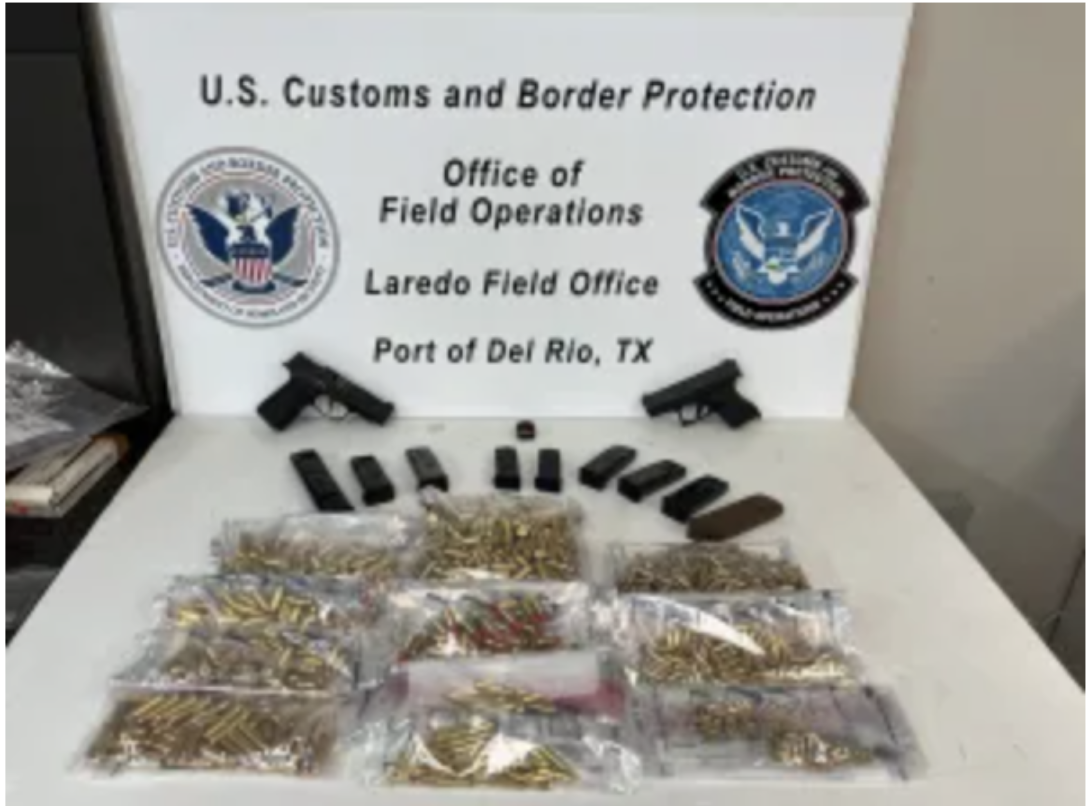
On December 21, CBP officers at the Del Rio International Bridge made a seizure that demonstrates exactly why border enforcement matters: two weapons, nine magazines, 1,389 rounds of ammunition, and a gun sight hidden in a vehicle headed to Mexico.
This wasn’t a small-time smuggling attempt. This was organized weapons trafficking with precision equipment designed to reach cartel operatives south of the border.
And it almost made it through.
What Actually Got Seized
Two weapons. Nine magazines. One precision gun sight. 1,389 rounds of ammunition.
That’s enough firepower to arm a small crew. That’s ammunition for sustained operations. That’s equipment designed for serious violence.
The weapons were hidden inside commodities in both the passenger van and the utility trailer it was pulling. Concealment indicates planning. Concealment indicates these weren’t just personal firearms—this was organized trafficking.
“Every weapon and round of ammunition seized represents a potential threat neutralized,” said Port Director Liliana Flores. “As this seizure illustrates, we will continue to leverage every resource to deter and disrupt illegal activities that threaten public safety.”
That’s the reality: these weapons were heading to Mexico. To cartel operatives. To organizations engaged in violence, drug trafficking, and territorial control.
Each weapon seized is a weapon that won’t be used to murder someone in Mexico. Each round is ammunition that won’t fuel cartel violence. Each magazine represents operational capacity that gets disrupted.
How CBP Caught It
This is where the system worked exactly as designed.
CBP officers conducting outbound operations—checking vehicles leaving the United States—selected the 2016 Chevrolet van for inspection. Standard procedure. Random selection based on risk assessment.
The vehicle and its trailer were referred for a nonintrusive inspection system scan. Advanced imaging technology that sees inside vehicles without opening them. X-ray technology that reveals what’s hidden.
Canine examination followed. Dogs trained to alert on weapons, explosives, and narcotics.
Both the imaging and the canines flagged the vehicle. Then physical inspection found the weapons.
This is layered security working: human decision-making, advanced technology, biological detection, physical verification. Each layer catches what the others might miss.
The Bigger Picture: Weapons Trafficking to Mexico
This single seizure is part of a pattern CBP encounters regularly at the southern border.
American firearms flow south. They’re purchased legally in the U.S., then smuggled across the border to Mexican cartels. The cartels use these weapons for violence, territorial control, and cartel operations.
Between 2014 and 2018, roughly 70% of firearms seized in Mexico originated in the United States. That rate hasn’t improved. American gun flows south. Mexican cartel violence continues.
When CBP seizes weapons at the border, they’re stopping that pipeline—at least temporarily. They’re preventing those specific weapons from reaching cartel operators.
But the flow continues. For every weapons seizure, how many get through? That’s the ongoing question.
Why This Matters for Border Communities
Del Rio sits on the Texas-Mexico border. This seizure happened exactly where the smuggling operation was attempting to cross.
For Del Rio residents, weapons seizures prove that law enforcement is working to keep cartel violence from flowing north. These weapons were headed south, but they represent exactly the threat that border communities face—organized crime activity, sophisticated smuggling operations, cartel-connected networks.
CBP’s mission includes stopping outbound weapons trafficking as well as stopping inbound narcotics, people, and contraband. This seizure represents that dual mission working.
The Investigation Forward
Homeland Security Investigations special agents have initiated a criminal investigation. HSI will:
- Identify the vehicle’s occupants
- Trace the weapons to their source
- Investigate the trafficking network
- Determine cartel connections (if any)
- Prosecute the smugglers
Criminal prosecution for weapons trafficking carries serious federal penalties. This isn’t a civil forfeiture. This is criminal conduct.
The driver/occupants now face federal weapons trafficking charges. Conviction means federal prison time.
The Smuggling Pattern
Weapons smuggling to Mexico follows a pattern:
Acquisition: Weapons purchased legally through licensed dealers or gun shows in the U.S.
Concealment: Weapons hidden in vehicles, compartments, cargo, utility trailers.
Transportation: Vehicles driven to border crossing points.
Crossing attempt: Vehicles attempt to cross at port of entry where they’re inspected.
Detection or evasion: Some get caught (like this seizure). Many get through.
The profit margins are enormous. A handgun costing $400 in the U.S. sells for $1,500+ in Mexico. The margins justify the risk for smugglers.
The motivation is cartel demand. Mexican cartels need American weapons to maintain operational capacity and territorial control.
What CBP Can Actually Do
CBP can inspect vehicles. CBP can use technology. CBP can deploy canines. CBP can make arrests and refer cases for prosecution.
But CBP can’t stop all weapons trafficking. With limited inspection resources and high vehicle volume, some weapons get through.
This seizure represents CBP doing what it can—catching weapons before they cross, disrupting networks, and referring cases for prosecution.
It’s not a complete solution. But it’s enforcement working.
The Federal Prosecution Piece
Once HSI takes over the case, prosecution becomes the focus. Federal prosecutors will bring charges. A federal court will try the case. If convicted, sentencing happens.
Federal weapons trafficking charges carry mandatory minimums. This isn’t a state charge with variable sentencing. Federal penalties are serious and consistent.
That prosecutorial pressure is what deters smuggling operations—the certainty of prosecution and substantial prison time.
Why Border Security Matters
Seizures like this prove why border enforcement is necessary. Weapons are flowing south. Drugs are flowing north. People are being trafficked. Contraband crosses in both directions.
CBP is responsible for disrupting that flow. This seizure represents that responsibility being executed.
Is it perfect? No. Do all smuggling attempts get caught? No. But the attempt to catch them is ongoing.
For Texas border communities, that enforcement is the difference between cartel violence being stopped at the border versus flowing into American communities.
The Bottom Line
CBP officers at Del Rio seized two weapons, nine magazines, 1,389 rounds of ammunition, and a gun sight hidden in a vehicle attempting to cross to Mexico. The seizure represents weapons trafficking being detected and disrupted at the border.
The weapons won’t reach cartel operatives. The smugglers face federal prosecution. The operation is disrupted.
This is what border security does: it stops weapons, drugs, and contraband at the crossing point before they reach their intended destinations.
One seizure doesn’t solve the problem. But it prevents specific violence. It disrupts specific networks. It sends a message that weapons trafficking gets caught and prosecuted.
That’s the ongoing work of border enforcement in Texas.