
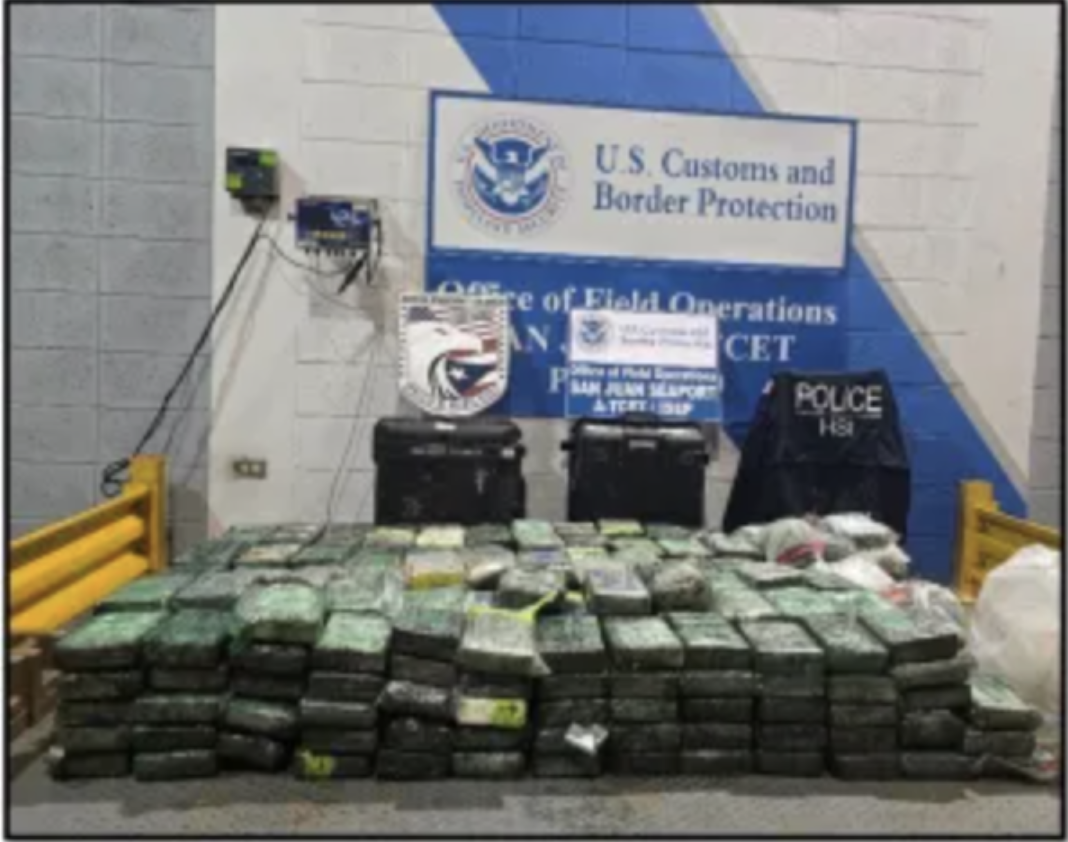
On Christmas Eve, while most people were wrapping gifts and preparing for the holidays, CBP officers at the Port of San Juan made a seizure that probably saved lives: 935 pounds of cocaine concealed inside a cargo trailer chassis arriving from the Dominican Republic.
$6.7 million worth of pure cocaine. Hidden in compartments built into the trailer frame itself. Almost made it through.
This is what happens when law enforcement stays vigilant while everyone else is celebrating.
The Seizure Details
The cocaine arrived hidden inside a flatbed cargo trailer chassis. Not in a package. Not in cargo boxes. Built into the actual structure of the trailer—concealed compartments designed specifically to hide narcotics from inspection.
The trailer was arriving aboard the M/V Kydon, a passenger and roll-on/roll-off vessel traveling from Santo Domingo, Dominican Republic, to San Juan, Puerto Rico.
CBP officers conducting routine inspection of inbound cargo noticed irregularities in the flatbed cargo platform chassis. Something wasn’t right. The structure looked off. The weight distribution seemed wrong. Whatever flagged their attention, they decided to investigate further.
K-9 units were deployed. Drug detection dogs trained to alert on cocaine and other narcotics. The dog alerted. Positive hit on narcotics.
Officers then conducted physical examination. They found the concealed compartments. They extracted 935 pounds of cocaine bricks.
The Sophistication of the Smuggling Operation
This wasn’t amateurs hiding drugs. This was organized.
Concealed compartments built into a cargo trailer chassis require engineering. They require knowing how to hide contraband in structural components where casual inspection won’t find it. They require understanding how cargo moves through ports and which vessels carry which cargo.
This is cartel-level smuggling. Professional equipment. Professional planning.
The fact that CBP caught it proves the value of trained officers and drug detection dogs. Without that expertise and attention to detail, 935 pounds of cocaine reaches Puerto Rico and flows into distribution networks.
Why This Matters for Puerto Rico
Puerto Rico is a U.S. territory. When cocaine arrives there, it becomes domestic distribution. It flows into Puerto Rican communities. It fuels addiction. It drives violence.
From Puerto Rico, cocaine also distributes northward to the mainland United States. Caribbean ports are major transit points for narcotics heading from South America to the U.S.
A 935-pound seizure represents supply chain disruption. It means less cocaine reaching consumers. It means dealers scrambling to replace lost product. It means temporary supply disruption in drug markets.
“Our officers remain vigilant and dedicated to protecting our borders, even during the holiday season,” said San Juan Area Port Director Kian Tomas. “This seizure highlights the commitment and professionalism of our team in preventing dangerous drugs from reaching our communities.”
That’s the reality: while people celebrated Christmas Eve, CBP officers were inspecting cargo. While families gathered, law enforcement worked to keep cocaine out of communities.
The Port of San Juan’s Strategic Importance
San Juan is one of the busiest Caribbean ports. Vessels arrive daily from Puerto Rico, the Dominican Republic, and throughout the Caribbean. Legitimate commerce flows constantly.
But so does smuggling. Criminal organizations use legitimate cargo and shipping operations to move narcotics. They hide drugs in containers, trailers, compartments within vessel structures. They exploit the volume and speed of legitimate commerce to move illegal cargo.
CBP’s job is to find it. They’re looking for contraband mixed in with legitimate cargo flowing through one of the busiest ports in the Caribbean.
One seizure on one day. But CBP is doing this every day across all Caribbean ports. The accumulation of seizures represents massive supply disruption.
The $6.7 Million Figure
935 pounds of cocaine at roughly $7,000 per pound (wholesale price in Caribbean markets) equals $6.7 million in wholesale value.
That’s money that doesn’t reach cartel operatives. That’s supply that doesn’t reach distribution networks. That’s profit the smuggling organization doesn’t make.
For every seizure, drug trafficking organizations lose money, lose product, and lose operational capacity. That pressure, applied consistently across all ports and checkpoints, disrupts the entire narcotics supply chain.
How CBP Catches This
The process is systematic:
Risk assessment: Officers evaluate vessels, cargo, and shipments based on intelligence, patterns, and risk factors.
Inspection selection: High-risk cargo gets selected for physical inspection.
Technology: Nonintrusive inspection systems scan cargo and containers for concealment and anomalies.
Canine detection: Drug detection dogs alert on narcotics odors.
Physical inspection: Officers examine cargo, containers, and structures where narcotics might be hidden.
Testing: Suspicious substances get tested to confirm they’re narcotics.
Seizure and investigation: Contraband is seized and cases are referred for criminal investigation.
This case followed that process. Something triggered inspection. The K-9 confirmed narcotics. Physical examination found the compartments. Cocaine was seized.
The Investigation Forward
CBP, the Puerto Rico Police Department, and Homeland Security Investigations are now investigating. They’ll:
- Trace the cocaine to its source
- Identify the smuggling organization
- Determine if occupants/owners are connected to cartels
- Prosecute the smugglers
Federal narcotics trafficking charges carry serious penalties. Conspiracy to distribute cocaine carries mandatory minimums and potential decades in federal prison.
The investigation is ongoing, which means more developments could come as law enforcement traces the shipment and identifies the network behind it.
The Cartel Supply Chain Reality
This seizure represents one segment of a larger South American-to-U.S. supply chain:
Cocaine produced in Colombia, Peru, and Bolivia → Trafficked through Caribbean ports → Hidden in cargo and containers → Shipped to Puerto Rico and mainland U.S. → Distributed through street-level networks → Reaches consumers
CBP operates at the Caribbean port segment. Their job is to intercept cocaine at that chokepoint before it reaches the U.S.
Every seizure at San Juan, every interdiction at a Caribbean port, reduces cocaine flowing into the U.S. market.
Why Holiday Enforcement Matters
Drug smugglers assume law enforcement is lighter during holidays. People are distracted. Officers might be understaffed. Border security might be relaxed.
The reality: CBP maintains full operations during holidays. Officers work Christmas Eve just like any other day. The mission doesn’t take breaks.
That dedication is what catches seizures like this one—on Christmas Eve, when cartels think border security is distracted.
The Bottom Line
CBP seized 935 pounds of cocaine worth $6.7 million from a cargo trailer arriving in San Juan on Christmas Eve. The cocaine was concealed in compartments built into the trailer chassis—professional smuggling operation disrupted by professional law enforcement.
The seizure represents:
- Supply disruption in narcotics markets
- Cartel revenue lost
- Cocaine that won’t reach consumers
- Smuggling organization disrupted
- Criminal network investigation underway
One seizure doesn’t end drug trafficking. But it saves lives. It disrupts supply. It holds smugglers accountable.
And it proves that border security doesn’t take holidays.