
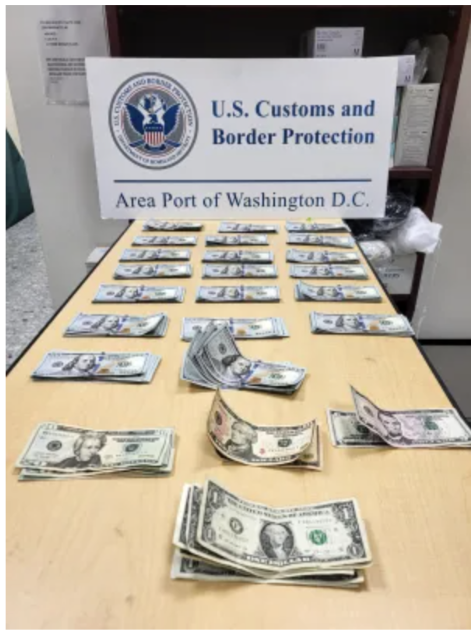
On a series of days in October, eight groups of travelers departed Washington Dulles International Airport heading to countries across Africa, Europe, and the Middle East. They were carrying cash. A lot of cash. Nearly $190,000 total.
They all broke the law. And CBP seized every dollar.
Here’s what happened—and why it matters if you’re planning any international travel.
The Seizures
The largest single seizure was almost $50,000 from a pair of travelers heading to Ghana on October 27.
They told CBP officers they had $9,250 in currency. CBP inspected their carry-on bags and found four envelopes containing $40,000 in unreported cash.
That’s a $40,000 lie. And it cost them everything.
Over several days in October, eight separate groups got caught doing the same thing—underreporting their currency to CBP.
Destinations for the seized currency holders:
- Belgium
- Ghana
- Jordan
- Saudi Arabia
- Senegal
- Togo
Total seizures: Nearly $190,000
Here’s The Law Everyone Breaks
You can travel with any amount of currency you want. There’s no limit. You can carry $1 million in cash if you want.
But—and this is critical—any amount over $10,000 must be reported to the U.S. Treasury using a form called FINCEN 105 (Report of International Transportation of Currency or Monetary Instruments).
That’s it. Report it. Pay nothing. No penalty. No consequences. Just fill out a form.
“Here’s the catch,” CBP explained. “Travelers can travel with any amount of currency and other monetary instruments that they choose, but any amounts over $10,000 must be reported to the U.S. Treasury.”
But these eight groups didn’t report. They lied. They underreported. And CBP caught them.
Why This Happens
CBP gave each traveler multiple chances. Officers asked verbally: “Do you have any currency over $10,000?” Travelers said no.
Officers asked them to declare it in writing. Travelers wrote down false amounts.
Then CBP inspected baggage. Found the cash. Asked again: “Are you sure that’s all?” Travelers still lied.
Only after gate-side examination did CBP find the hidden envelopes with thousands in additional cash.
Why do people do this? CBP identified two reasons:
Greed: People want to avoid reporting because they think reporting somehow makes them vulnerable. They don’t want records of large cash movements. They think unreported cash is safer.
Illegal Activity: Some unreported bulk currency is proceeds from fraud, money scams, or other crimes. People smuggle unreported cash to hide the origin or destination of illegal money.
Either way, it’s a federal crime.
The Consequences
When CBP seizes unreported currency, you lose it. All of it. The eight groups lost $190,000 combined.
But the consequences don’t stop there:
You might miss your flight. The CBP inspection takes time. If they find undeclared currency, you’re getting thoroughly inspected. Your flight might leave without you.
You face potential criminal prosecution for bulk currency smuggling. That’s not a civil penalty. That’s a criminal charge. That means lawyers, court, and potentially prison time.
“Violators face potential criminal prosecution for bulk currency smuggling,” CBP stated flatly.
The Easy Solution
CBP made this incredibly simple. You have two options:
Option 1: Fill out FINCEN Form 105 online BEFORE you go to the airport. Visit https://fincen105.cbp.dhs.gov and complete it. Takes a few minutes. You’re done.
Option 2: Ask CBP officers at the airport to help you fill it out. They’ll assist you. It still takes just a few minutes.
“It takes just a few minutes,” CBP emphasized. “CBP even streamlined the compliance process so that travelers can complete and submit the FINCEN form 105 online at https://fincen105.cbp.dhs.gov prior to arriving at their airport departure gate.”
That’s it. Comply. Keep your money. Travel without worry.
Why CBP Is Pushing This Now
It’s holiday season. People are traveling internationally. They’re visiting family in other countries. They’re taking cash to buy gifts or give as presents.
CBP understands this. “It’s the holiday season and we know that people will travel internationally to a vacation spot or to spend time with family. We also understand that many travelers will be transporting currency to buy gifts for, or to present as a gift to family,” said Christine Waugh, CBP’s Area Port Director.
But understanding doesn’t change the law. You still have to report. And CBP is still watching at the airport.
“We urge you to save yourself time and inconvenience, and guard against a possibly delayed start to your travel plans by truthfully complying with our nation’s currency reporting laws,” Waugh said.
The Scale of The Problem
This isn’t unique to Dulles. This is happening at every major airport.
In fiscal year 2024 alone, CBP seized an average of $152,418 in unreported or illicit currency every single day along America’s borders.
That’s $55.6 billion annually in seized currency. Every day.
The problem is massive. People just don’t know about this law. Or they think they can hide it. Or they’re actually moving illegal money.
For Texas Travelers
If you’re flying internationally from DFW, Houston, Austin, San Antonio, or El Paso, the same rules apply. CBP officers at those airports are conducting the same inspections.
If you’re carrying more than $10,000 in cash, report it. Fill out the form online before you arrive at the airport. Don’t lie. Don’t hide it. Don’t think you’re clever.
CBP will catch you. And you’ll lose everything.
The Real Message
This isn’t about being paranoid or government overreach. This is about following a simple rule that protects the financial system.
Currency reporting laws exist to prevent money laundering and illegal financial activity. They’re designed to track where large amounts of money are moving internationally.
If you’re moving money legally, you report it. You keep your money. You travel without incident. No problem.
If you’re hiding money, CBP catches you. You lose it. You might get prosecuted.
It’s that simple.
What To Do
If you’re traveling internationally with more than $10,000:
- Fill out the FINCEN 105 form online
- Complete it before arriving at the airport
- Keep your receipt
- Travel with peace of mind
Or:
- Arrive at the airport early
- Tell CBP you’re carrying currency over $10,000
- Ask them to help you fill out FINCEN 105
- Complete it at the gate
- Travel without worry
Don’t lie. Don’t hide it. Don’t underreport. Don’t think you’re clever.
Eight groups of travelers just learned that lesson the hard way. They lost nearly $190,000 combined because they didn’t fill out a simple form.
Don’t be them.
The Law:
- Travel with any amount of currency—no limit
- Amounts over $10,000 must be reported to U.S. Treasury via FINCEN 105
- Reporting is FREE
- No penalties for reporting
- Severe penalties for not reporting (seizure, prosecution, criminal charges)
How to Report:
Online (Before Airport):
- Fill out form
- Takes 5 minutes
- Keep receipt
At Airport:
- Tell CBP officer you have currency over $10,000
- Ask for assistance with FINCEN 105
- Complete at gate
- Keep receipt
What Happens If You Don’t Report:
- CBP seizes all unreported currency
- You lose the money—permanently
- You might miss your flight
- You face potential criminal prosecution for bulk currency smuggling
- You could face fines and jail time
Average Daily Seizures (FY 2024):
- $152,418 per day in unreported/illicit currency
- $55.6 billion annually seized at U.S. borders
Recent Dulles Seizures (October 2025):
- 8 groups of travelers
- Nearly $190,000 total
- Largest single seizure: $50,000
- All for underreporting or not reporting currency