

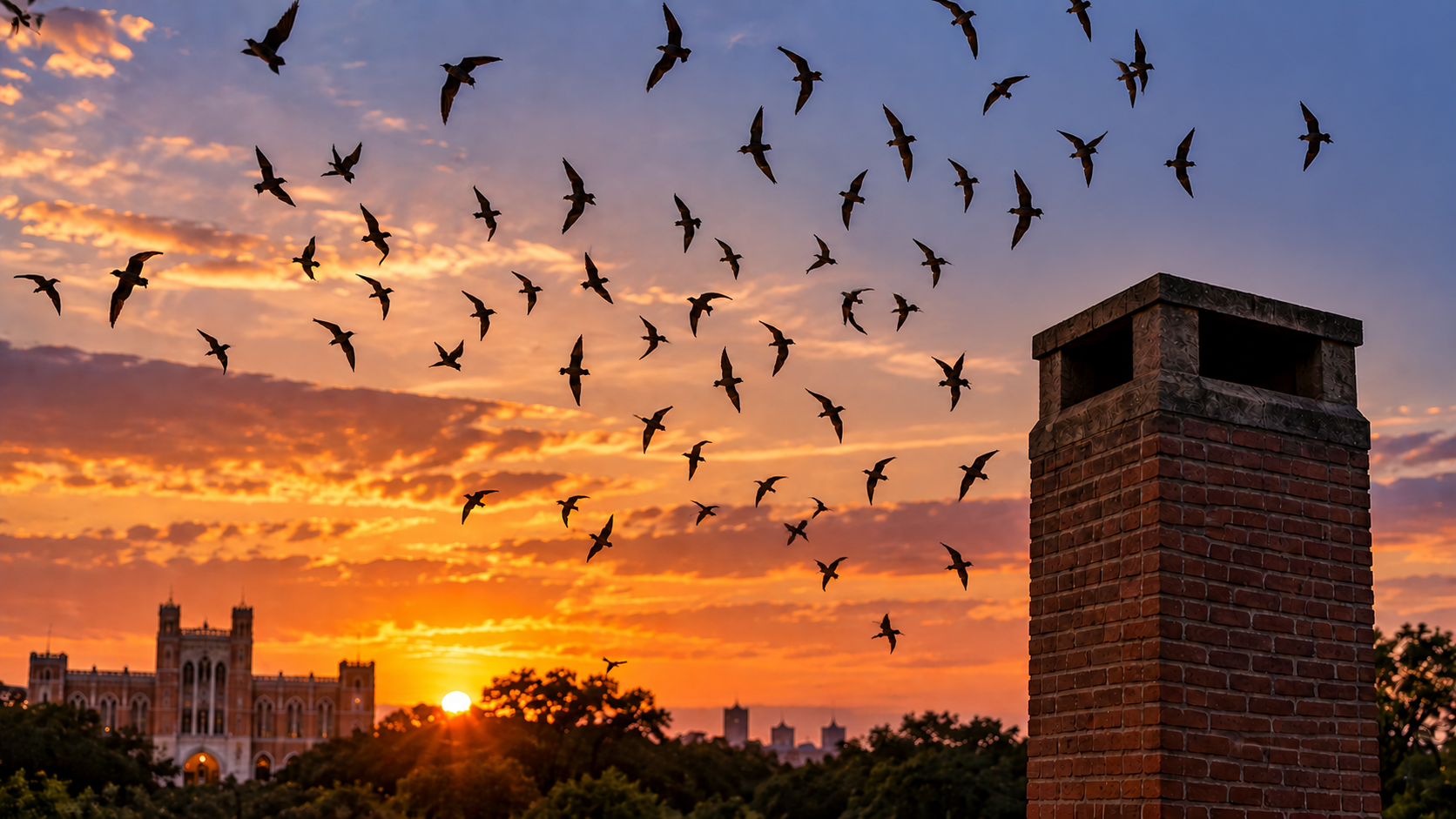
Hundreds of tiny birds are about to put on one of nature’s strangest, most mesmerizing shows, and you don’t need to leave Houston to see it.
Rice University, Houston, TX — Tuesday, September 30, 2026, at sunset
There’s a particular kind of magic in watching something ordinary become extraordinary right as the sun goes down. That’s exactly what happens at a Swift Night Out, when hundreds of small, cigar-shaped birds suddenly appear overhead, circle tighter and tighter, and then pour themselves into a chimney like smoke running in reverse.
Birds Houston, the nonprofit formerly known as Houston Audubon before its rebrand this past August, is hosting its next Swift Night Out at Rice University on September 30. The event is free and family-friendly, starting right at sunset, so it’s worth arriving a little early to get settled before the real show begins. Birds Houston posts exact meeting-spot details on campus closer to each event date, so check birdshouston.org or their social pages in the days leading up. A folding chair, some mosquito repellent, and a water bottle go a long way toward making the evening comfortable. Binoculars are entirely optional, since the swifts fly close enough and gather in high enough numbers to see with the naked eye.
The star of the show is the chimney swift, a small, sooty-gray bird that spends almost its entire life in the air. These birds eat, drink, and even mate on the wing, only stopping to roost at night or nest during breeding season. They’re remarkably fast fliers too, reaching speeds up to 36 miles per hour, and they’re serious pest control: with tiny hairlike feathers framing their mouths, they funnel thousands of flying insects, beetles, moths, flying ants, mosquitoes, down their throats every single day. By late summer, chimney swifts finish breeding and start gathering in large communal roosts each evening before beginning a long migration south to the Amazon basin in Brazil, Peru, and Colombia for the winter. That gathering behavior is exactly what makes Swift Night Out possible: for a few weeks each fall, you can reliably find hundreds, sometimes thousands, of these birds funneling into a single chimney at dusk.
Chimney swifts and their roosting spectacle aren’t unique to Rice University. They range across most of the eastern half of North America during breeding season, but Texas happens to sit in a genuinely special spot for watching them, right along one of the busiest migration corridors on the continent, funneling millions of birds south each fall toward Mexico and Central and South America. It’s not a coincidence that the whole Swift Night Out movement actually started here. The tradition traces back to a continent-wide citizen science effort launched in 2001 by longtime swift researchers Paul and Georgean Kyle in Austin, who spent years studying the birds up close before the idea spread nationwide. Within the Houston area alone, Birds Houston has hosted Swift Night Out events at multiple sites over the years beyond Rice, including Pershing Middle School, Sky High Sports in Spring Branch, Lakeview Elementary in Sugar Land, and a Whole Foods Market location in Bellaire. Just this week, a Swift Night Out at Pershing Middle School drew about four dozen spectators who watched a volunteer with a hand-held clicker count 605 chimney swifts pouring into the school’s preserved brick chimney at sunset.
That Pershing chimney has its own small piece of local history worth knowing. It nearly didn’t survive at all. During construction of the school’s new campus back in May 2007, Texas Parks and Wildlife Department game wardens and bird advocates stepped in specifically to preserve the chimney because of its importance as a swift roosting site, a rare case of a construction project bending around a bird’s flight path rather than the other way around.
There’s a quieter story running underneath all this spectacle, too. Chimney swifts once relied on hollow trees for roosting, long before humans ever built a chimney, and as old-growth forests disappeared, the birds simply adapted, finding brick chimneys to be a pretty good substitute. Now that story is flipping again, as older chimneys keep getting capped, torn down, or replaced during renovations, leaving swifts with fewer and fewer places to land each fall. That slow disappearance is part of why these evening gatherings have become a small tradition for birders and conservationists, with every swift counted adding a data point that helps track population trends and identify which roosting sites are worth protecting.
None of that science is really necessary to enjoy the evening, though. Kids especially tend to fall for it instantly, there’s something irresistible about watching a swirling cloud of tiny birds suddenly funnel into a single chimney like it’s been choreographed. Grab a blanket, bring the family, and let the swifts do the rest.