
It’s 1877, and most folks are still using outhouses and oil lamps. But in Fulton, Texas, there’s a mansion with flushing toilets, central heating, and gas lighting. Welcome to the future, Victorian-style.
The House That Shouldn’t Exist
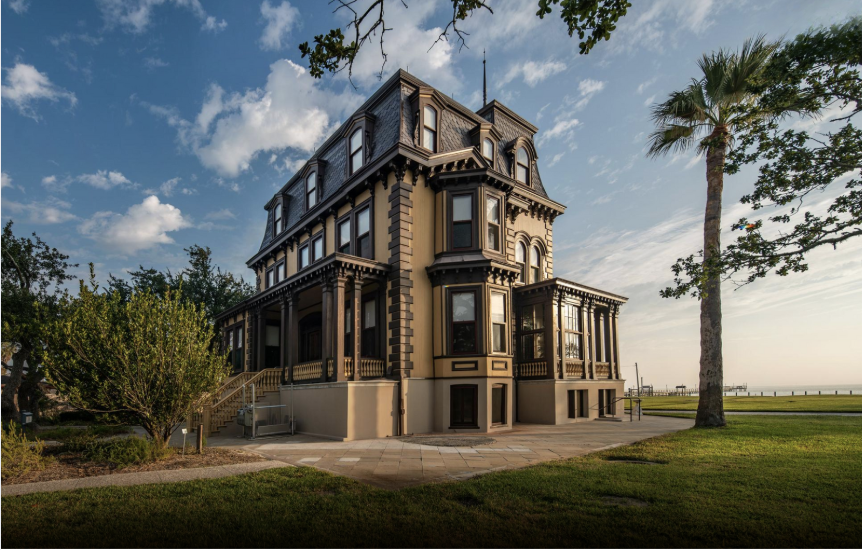
Perched above Aransas Bay sits Fulton Mansion, a French Second Empire masterpiece that looks like it belongs in Paris, not coastal Texas. Built between 1874-1877, this four-story giant has that distinctive mansard roof and ornate trim that screams “I’ve got money and I’m not afraid to show it.”
But here’s what makes it incredible: George W. Fulton wasn’t just showing off. He was engineering the future.
The Couple Who Built Tomorrow
George Fulton started as a teacher in Indiana, but he had the vision of an entrepreneur and the brain of an engineer. When he married Harriet Smith Fulton – daughter of Republic-era Texas governor Henry Smith – he didn’t just get a wife. He got 28,000 acres of prime coastal land and the funding to build something extraordinary.
Together, they didn’t just build a house – they built modern Texas. George co-founded the Coleman-Fulton Pasture Company in 1871, which grew into one of the largest cattle empires in Texas history, spanning over 265,000 acres across four counties. He pioneered fencing the open South Texas range (revolutionary at the time), invented the world’s first chilled slaughterhouse, and developed innovative methods for shipping cattle by boat from company wharves.
While George was transforming the cattle industry, he literally founded the town of Fulton and introduced improved cattle breeds that pushed Texas agriculture into the modern era. Harriet designed the gardens and managed their sprawling household that became the center of coastal Texas society.
Why This House Was Light-Years Ahead
While your great-great-grandparents were hauling water from wells, the Fultons had indoor plumbing throughout their mansion. Gas lighting illuminated rooms when neighbors were trimming wicks. Central heating kept them comfortable while others fed wood stoves all winter.
The engineering was brilliant: solid pine plank walls instead of studs, a basement cistern system for water, and a cast-concrete foundation that could weather anything the Gulf Coast threw at it. George built this house to last centuries, not decades.
The Ultimate Survival Test
When Hurricane Harvey slammed Texas in 2017, the Fulton Mansion proved George’s engineering genius. After 140 years of Gulf storms, the house stood strong. Sure, it needed repairs afterward, but the fact that it survived at all shows you what real craftsmanship looks like.
This wasn’t luck – this was a man who understood that if you’re going to build on the coast, you’d better build right.
What Happened After
George died in 1893, and Harriet left the mansion in 1906, passing away in 1910. The house changed hands multiple times until Texas stepped in during 1976, recognizing they had something special. By 1983, the state had fully restored the mansion to its original glory.
Today, the Texas Historical Commission runs it as a state historic site, offering tours Tuesday through Saturday (10 a.m.-4 p.m.) and Sunday (1 p.m.-4 p.m.). Adults pay about $7, kids under 5 get in free.
Your Weekend Time Machine
This isn’t just another old house tour. You’re walking through the most technologically advanced home in 1870s Texas. Every room tells the story of a couple who refused to accept “that’s just how things are done.”
Start in the Education & History Center, then explore the mansion and those meticulously maintained gardens Harriet designed. You’ll see innovations that were decades ahead of their time, all wrapped in Victorian elegance that still takes your breath away.
The Takeaway
Fulton Mansion proves that true innovation never goes out of style. George and Harriet Fulton built a house that was the iPhone of its era – so far ahead of everything else that people couldn’t believe it was real. A century and a half later, after countless storms and changing times, their vision still stands strong above Aransas Bay.
Fulton Mansion State Historic Site, Fulton, Texas. Because sometimes the most impressive technology is the kind that lasts 150 years.