

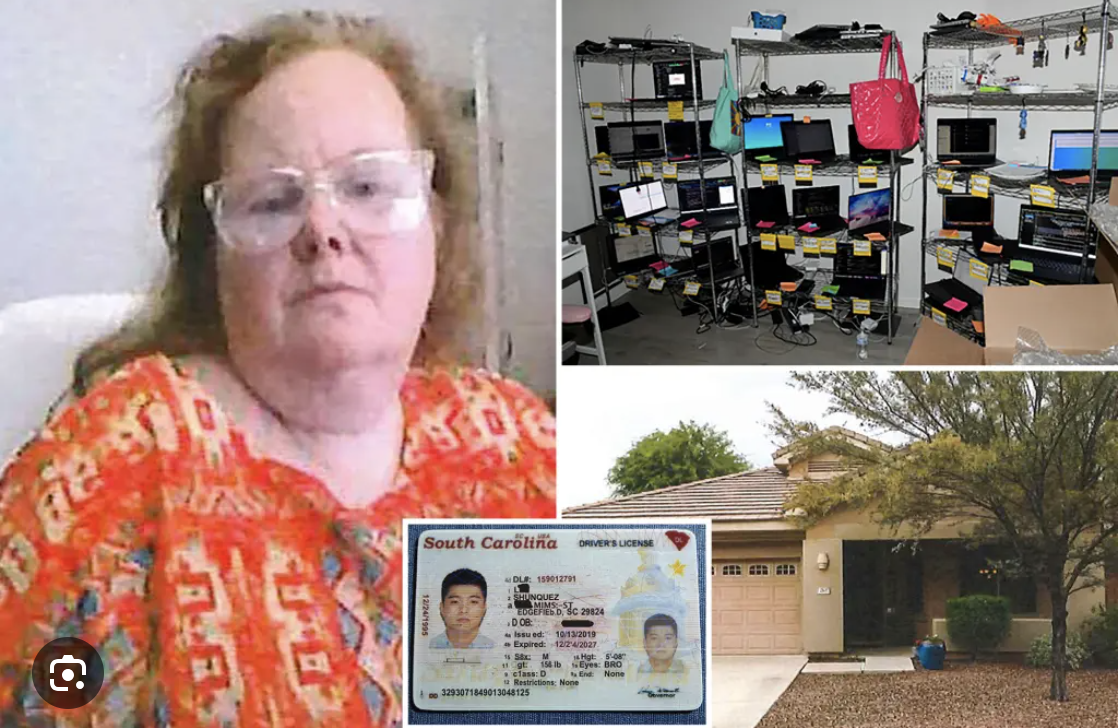
You know that feeling when you hear about a scam so brazen it makes you wonder how anyone thought they’d get away with it? Meet Christina Marie Chapman, a 50-year-old Arizona woman who just got sentenced to over eight years in prison for running what prosecutors are calling one of the most elaborate North Korean fraud schemes ever prosecuted in the United States.
But here’s the kicker – this isn’t some isolated incident. This is part of a massive, ongoing operation that’s been quietly infiltrating American companies for years, and Chapman is just the latest American citizen caught helping our adversaries steal millions right from under our noses.
The “Laptop Farm” That Fooled 309 Companies
Chapman turned her Litchfield Park home into what investigators are calling a “laptop farm” – a sophisticated operation where she stored over 90 company laptops, each carefully labeled with notes identifying which U.S. company and stolen identity went with each device.
Chapman helped North Korean IT workers obtain jobs at 309 U.S. companies, including Fortune 500 corporations. The impacted companies included a top-five major television network, a Silicon Valley technology company, an aerospace manufacturer, an American car maker, a luxury retail store, and a major media and entertainment company.
The scheme was breathtakingly simple yet devastatingly effective: North Korean IT workers would apply for remote jobs using stolen American identities, and Chapman would receive the company laptops at her Arizona home. The workers would then remotely access these computers from thousands of miles away, making it appear like the work was being done right here in the United States.
This is Part of Something Much Bigger
What makes this case particularly alarming is that Chapman’s operation wasn’t a one-off scheme. The Justice Department today announced the indictment of North Korean nationals Jin Sung-Il (진성일) and Pak Jin-Song (박진성), Mexican national Pedro Ernesto Alonso De Los Reyes, and U.S. nationals Erick Ntekereze Prince and Emanuel Ashtor for a fraudulent scheme to obtain remote information technology work, showing this is happening nationwide.
“They are wildly successful,” said Google Threat Intelligence Group expert Michael Barnhart, who has been tracking North Korea and collecting intelligence broadly for decades. The scope is staggering – experts estimate thousands of North Korean IT workers have successfully infiltrated Fortune 500 companies across the country.
The Human Cost Behind the Headlines
This wasn’t just corporate fraud – it was identity theft on a massive scale. Chapman and her co-conspirators stole the identities of 68 real Americans, filing false tax returns and Social Security reports in their names. Imagine discovering that someone has been working full-time jobs using your name and Social Security number, generating income that gets reported to the IRS under your identity.
“Christina Chapman perpetrated a years’ long scheme that resulted in millions of dollars raised for the DPRK regime, exploited more than 300 American companies and government agencies, and stole dozens of identities of American citizens,” said Acting Assistant Attorney General Matthew R. Galeotti.
Why This Should Worry Every American Company
U.S. Attorney Jeanine Ferris Pirro put it bluntly: “North Korea is not just a threat to the homeland from afar. It is an enemy within… If this happened to these big banks, to these Fortune 500, brand name, quintessential American companies, it can or is happening at your company.”
The reality is sobering: This coordinated DOJ and FBI operation addresses an ongoing national security and economic threat, as North Korea’s use of remote IT workers enables it to generate substantial offshore funding to evade international sanctions and bolster the regime.
The Money Trail That Funded Nuclear Weapons
Where did that $17 million go? Straight to North Korea’s weapons programs. Chapman wasn’t just helping people get jobs – she was actively funding one of America’s most dangerous adversaries. She received and laundered payroll checks, transferred money overseas, and even shipped 49 company laptops to locations near the North Korean border.
The Justice Department ordered Chapman to forfeit $284,555.92 that was destined for North Korean operatives and pay an additional judgment of $176,850. But the real damage – the millions that already made it to North Korea’s nuclear program – can’t be undone.
A Pattern That’s Getting Worse
What’s truly alarming is how sophisticated and widespread this operation has become. While Americans in the U.S. have been indicted for knowingly taking part in the North Korean IT worker scheme by renting out their identities or hosting laptop farms in their homes, in Kim’s experience, the Americans who were involved in the scheme were unwitting.
This means there are likely thousands more American companies unknowingly employing North Korean IT workers right now, generating revenue for a regime actively developing weapons aimed at the United States.
What Companies Need to Do Right Now
FBI Assistant Director Rozhavsky made it clear: “However, even an adversary as sophisticated as the North Korean government can’t succeed without the assistance of willing U.S. citizens like Christina Chapman.”
The message to American businesses is urgent: verify your remote employees. That talented developer who always delivers excellent work but never turns on their camera during meetings? The IT specialist who’s oddly unavailable during certain hours? These could be red flags worth investigating.
The Bottom Line
Chapman’s 102-month sentence sends a clear message, but it’s just one victory in what appears to be a much larger battle. With The indictment describes a multi-year fraud scheme by Wang and his co-conspirators to obtain remote IT work with U.S. companies that generated more than $5 million in revenue representing just another recent case, the scope of North Korean infiltration into American companies is becoming impossible to ignore.
This isn’t just about one Arizona woman who made some bad choices. This is about a foreign adversary successfully embedding thousands of operatives into the heart of American business, generating millions for weapons programs while we unwittingly write the paychecks.
Chapman’s case is closed, but the larger threat is just getting started. The question now is: how many more Christina Chapmans are out there, and how many American companies are unknowingly funding North Korea’s nuclear ambitions?
The call is coming from inside the house – and it’s time American businesses start picking up the phone.