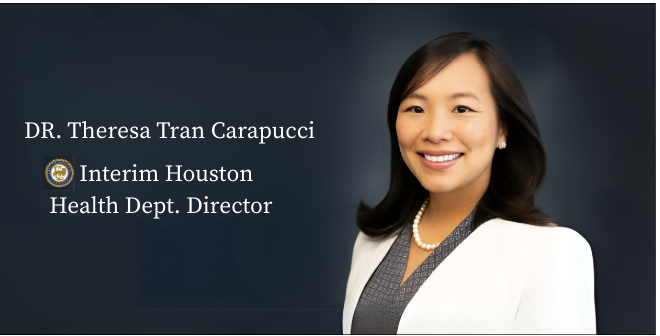
Houston just got a new quarterback for its health game, and she’s exactly what the city needs right now. Mayor John Whitmire’s appointment of Dr. Theresa Tran Carapucci as interim Houston Health Department Director isn’t just another city hall shuffle – it’s a strategic move that puts a proven leader with both medical expertise and policy innovation at the helm of one of America’s most diverse cities’ biggest health challenges.
Who Is Dr. Tran? Your New Health Department Director
Dr. Tran is a board-certified emergency physician with expertise in health policy and management who serves as UT Health Associate Vice President for Clinical Population Health and Advocacy, School of Public Health Assistant Dean for Clinical Population Health and Advocacy, and Assistant Professor in multiple departments. Translation? She’s been working at the intersection of frontline medicine and health policy – exactly where Houston needs her most.
Her credentials read like a wish list for the perfect health director:
- M.D. (Doctor of Medicine)
- M.B.A. (Master of Business Administration)
- F.A.C.E.P. (Fellow of the American College of Emergency Physicians)
- More than a decade of frontline clinical experience
- Distinguished career combining patient care, health policy, and system management
What Her Role Actually Means for You
The Houston Health Department isn’t just about restaurant inspections and flu shots (though those matter too). The department is a full-service health department that performs many enhanced functions to address health inequities, with services that benefit all Houston residents while taking additional steps to support those most in need, such as low-income mothers and children, the elderly, and minority populations.
Dr. Tran will oversee:
- Disease surveillance and outbreak response – Think COVID-19 management, but also monitoring everything from foodborne illnesses to chronic disease patterns
- Environmental health protection – Air quality monitoring, water safety, and addressing environmental hazards in Houston’s industrial corridors
- Community health programs – Vaccination campaigns, maternal health initiatives, and chronic disease prevention
- Health equity initiatives – Strategies to address COVID-19 health disparities and health inequities
- Emergency preparedness – Houston faces hurricanes, floods, and other disasters regularly
- Policy development – Working with City Council and community partners to create health-focused policies
Why Her Background Makes Perfect Sense for Houston
Houston isn’t just any city – it’s the most diverse major city in America, with residents speaking over 140 languages and representing cultures from across the globe. Dr. Tran’s unique combination of emergency medicine experience and policy expertise positions her to tackle Houston’s specific challenges.
Her Emergency Medicine Background Matters Because:
- Emergency departments see Houston’s health disparities up close every single day
- ER doctors understand how social determinants of health affect patient outcomes
- She has special interest in leveraging direct frontline representation to inform system policy and management decisions
- Emergency medicine requires quick decision-making under pressure – essential for public health crises
Her Policy and Management Experience Is Crucial For:
- Navigating complex city bureaucracy and budget processes
- Building partnerships with hospitals, community organizations, and state agencies
- Developing evidence-based programs that actually work in diverse communities
- Securing funding for innovative health initiatives
The Houston Health Challenges She’s Inheriting
Houston faces health challenges that would make other cities break a sweat. Dr. Tran is walking into a role that requires addressing:
Health Disparities: Houston has significant gaps in health outcomes between different neighborhoods and populations. Areas like the Third Ward and Fifth Ward face challenges that wealthier neighborhoods don’t see.
Air Quality Issues: Houston’s petrochemical industry and traffic congestion create air quality challenges that affect respiratory health, especially in certain zip codes.
Hurricane and Flood Preparedness: Climate change means Houston faces increasing extreme weather threats that require coordinated health responses.
Access to Care: Despite having the world’s largest medical center, many Houston residents still struggle to access affordable healthcare.
Chronic Disease Prevention: Diabetes, heart disease, and obesity rates in Houston mirror national trends but require localized solutions.
What We Can Expect from Dr. Tran’s Leadership
Based on her background and Mayor Whitmire’s statements, expect to see several key focuses:
Data-Driven Decision Making: Her research background suggests she’ll use Houston’s health data to target interventions where they’re needed most.
Community Partnerships: Her UTHealth experience shows she understands how to build relationships between academic institutions, healthcare providers, and community organizations.
Innovation in Service Delivery: Her MBA and policy background indicate she’ll look for creative ways to deliver health services more effectively.
Equity-Focused Initiatives: Her community engagement experience suggests prioritizing programs that address Houston’s health disparities head-on.
Emergency Preparedness: Her emergency medicine background positions her well for Houston’s disaster-prone geography.
Why This Appointment Matters More Than You Think
The Houston Health Department Director position isn’t just another city job – it’s a role that directly affects every Houstonian’s quality of life. From the restaurant you ate at yesterday to the air you’re breathing right now, health department decisions ripple through daily life.
Dr. Tran’s appointment is significant because:
- She brings both clinical credibility and management experience
- Her policy background means she can navigate city politics effectively
- Her emergency medicine experience prepares her for Houston’s crisis-prone environment
- Her academic background suggests she’ll use evidence-based approaches
- Her diverse experience positions her to address Houston’s complex demographics
The Transition Timeline
Dr. Tran’s appointment requires City Council confirmation, scheduled for Wednesday, September 3rd. She’ll be taking over from Stephen Williams, who served the Houston Health Department for 21 years – meaning she’s inheriting both institutional knowledge and the need for fresh perspectives.
What This Means for Houston’s Future
Mayor Whitmire’s choice signals a commitment to treating public health as both a medical issue and a policy challenge. Dr. Tran’s unique background suggests Houston is preparing for a more integrated approach to community health – one that connects emergency response, chronic disease prevention, environmental health, and health equity under unified leadership.
“Her background as both a physician and a health policy leader ensures that our city is prepared to address today’s challenges while building a healthier future for every Houstonian,” Mayor Whitmire said, and that combination of present-focused crisis management and future-oriented planning is exactly what Houston needs.
The Bottom Line
Houston just hired a health director who’s spent her career working at exactly the intersection the city needs – where frontline medical care meets policy innovation. Dr. Tran’s emergency medicine background gives her credibility with healthcare providers, her policy experience gives her tools for systemic change, and her management experience gives her the skills to lead a complex city department.
For Houstonians, this appointment represents an investment in evidence-based, equity-focused public health leadership. In a city where your zip code shouldn’t determine your health outcomes, Dr. Tran’s appointment suggests Houston is serious about making that aspiration a reality.
The real test will be how effectively she can translate her impressive credentials into improved health outcomes for Houston’s 2.3 million residents. But based on her background, Houston just got a health director who understands that good public health requires both excellent medical knowledge and the policy skills to make change happen at scale.