
WASHINGTON — The Department of Homeland Security announced that the 2026 FIFA World Cup, which concluded last Sunday, closed without any major security incidents at any stadium or Fan Festival across the United States, according to DHS. The tournament ran 38 days on U.S. soil with 78 matches played, including 15 in Texas.
According to DHS, the security effort was coordinated across the entire department and involved every DHS component alongside federal, state, and local law enforcement partners. Components involved included U.S. Customs and Border Protection (CBP), Cybersecurity and Infrastructure Security Agency (CISA), Federal Emergency Management Agency (FEMA), U.S. Immigration and Customs Enforcement (ICE), Homeland Security Investigations (HSI), U.S. Secret Service, Transportation Security Administration (TSA), U.S. Coast Guard, Science and Technology Directorate, Office of Intelligence and Analysis, Office of Homeland Security Situational Awareness, Office of Health Security, and Federal Protective Service.
By the numbers
According to DHS, the department’s World Cup enforcement operations included the following results:
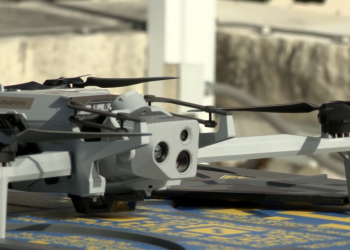
More than 700 unauthorized drones seized — jointly by DHS and the FBI. Restricted airspace around every venue was enforced through counter-drone operations that ran throughout the tournament.
More than 50 air missions flown by CBP’s Air and Marine Operations over stadiums and host cities.
More than 19,000 inspections of vehicles headed into stadiums and Fan Festivals conducted by CBP.
More than 473,000 counterfeit FIFA World Cup merchandise items seized by CBP, with an estimated genuine retail value of more than $33 million.
More than 673 criminal arrests on human trafficking charges, with 61 adults and 13 minors rescued by ICE and HSI.
48 arrests and 164 seizures in HSI intellectual property rights enforcement, including more than 530,000 counterfeit goods with an estimated $85 million retail value.
Texas at the center of the World Cup security operation
Texas played a central role in both the tournament and the federal security operation.
Dallas hosted nine matches at AT&T Stadium in Arlington — the highest number of any North American host city. Fair Park in Dallas served as the Fan Fest site, drawing an estimated 35,000 daily visitors, and the Kay Bailey Hutchison Convention Center served as the World Cup’s official international broadcast hub.
Houston hosted six matches at Houston Stadium (NRG Stadium), with more than half a million visitors expected in the city during the tournament. The city received $64.7 million in federal security funding.
Most significantly, the FBI’s International Police Cooperation Center (IPCC) — the global command post coordinating security across all World Cup host cities — was located in Houston, linking law enforcement from 46 countries during the tournament.
According to Governor Greg Abbott’s office, the Texas Public Safety Office awarded $116 million in FIFA Public Safety Grants to Texas host cities to fund additional security personnel, equipment, and coordination.
Statement from the Secretary
“In one of the most complex security environments we’ve faced, DHS and our components helped deliver a safe and secure tournament while showcasing American exceptionalism. I want to thank the state and local law enforcement agencies across the country, as well as our federal partners, who worked around the clock to help keep millions of fans and visitors safe,” DHS Secretary Markwayne Mullin said in a statement. “Watching this tournament unfold and seeing the coordination behind the scenes has been extraordinary. Thank you, President Trump, for bringing this vision to life and showcasing America to the world.”
About the tournament
According to DHS, the 2026 FIFA World Cup was co-hosted by the United States, Canada, and Mexico and marked the first time in the tournament’s history the format expanded from 32 to 48 teams. The tournament spanned 39 days and consisted of 104 total matches across the three host nations. It is regarded as the largest sporting event in history.
A word for Texas readers
For 39 days this summer, Texas was at the heart of one of the most complex security operations in American history. Fifteen World Cup matches played in Dallas and Houston. Half a million-plus visitors moved through the state. Federal, state, and local law enforcement — including thousands of Texans in uniform — coordinated around the clock to make sure nothing went wrong.
Now that the tournament has concluded, the memory that will linger longest for Texans isn’t just the goals scored, the crowds cheered, or the international fans who filled the streets. It’s the quiet, comprehensive work that made all of that possible — the work of the FBI Houston field office, Dallas Police Department, Houston Police Department, Harris County Sheriff’s Office, Texas DPS, Fair Park security, Arlington PD, and the thousands of officers, analysts, and coordinators who kept Texas safe while the world watched.
To all of them: thank you.
Sources: U.S. Department of Homeland Security; Federal Bureau of Investigation; City of Dallas; City of Houston; Office of the Governor of Texas