
Want to try something completely different this Monday night? The Austin Public Library is bringing back one of animation’s most magical techniques – and you can learn it for free at the Howson Branch on August 18th.
The Film Strip Club’s 16mm Direct Animation Workshop isn’t your typical digital art class. This is hands-on filmmaking using techniques that were groundbreaking in the 1930s and are still mesmerizing audiences today.
What You’ll Actually Do
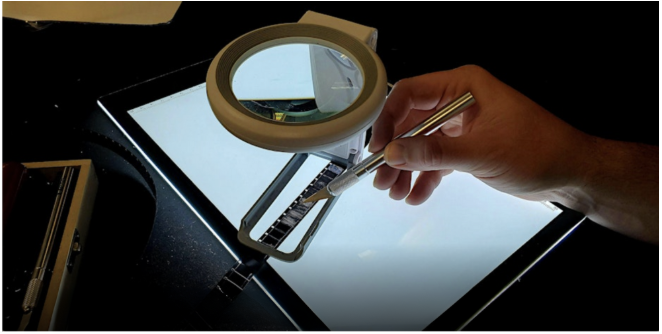
Direct Animation, also known as Scratch Film, is the process of drawing and scratching designs directly onto 16mm filmstrips. You’ll learn three main techniques that create effects impossible to achieve any other way:
- Paint on transparent film – On blank film the artist can draw, paint, stamp, or even glue or tape objects
- Manipulate developed film – Work with images already on film to create new effects
- Scratch black film leader – The filmmaker takes film stock that has already been developed, turning the image black, and uses tools to scratch its surface. The scratches can either be left as is, coming out as white light, or filled in with colour
Then you’ll run your creation through a real 16mm projector to see your art come alive on screen.
The Surprising History Behind This Art Form
This technique has serious artistic pedigree. In 1935 Len Lye created the first direct film screened to a general audience, a promotion for the British General Post Office entitled A Colour Box – a film that still looks stunning today.
Norman McLaren was a Scottish-Canadian animator, director and producer known for his work for the National Film Board of Canada (NFB). He was a pioneer in a number of areas of animation and filmmaking, including hand-drawn animation, drawn-on-film animation, visual music, abstract film. By the time of Begone Dull Care (1949), McLaren had mastered a vast array of handmade filmmaking techniques.
The first and best known practictioners of drawn-on-film animation include Len Lye, Norman McLaren, Stan Brakhage, then later artists including Steven Woloshen, Richard R. Reeves and Baerbel Neubauer, who produced numerous animated films using these methods.
Why This Matters in 2025
In our digital world, there’s something powerful about working directly with physical film. Each frame of the film is a canvas, with the artist’s direct touch creating movement and narrative as the film runs through a projector. No software, no screens – just you, the film, and whatever tools you choose to mark it with.
The workshop description promises you’ll “expose the vibrant colors of your inner experimental filmmaker” – and that’s not just marketing speak. This technique forces you to think differently about animation and time-based art.
What You Need to Know
When: Monday, August 18, 6:00-7:45 PM
Where: Howson Branch, Austin Public Library, 2500 Exposition Boulevard, Austin, TX 78703
Cost: Free
Parking: Free venue parking available
Age: 18+
The workshop runs monthly through October, so you can attend one session for a quick project or multiple sessions to develop something longer. Plus, they’ve partnered with the Texas Archive of the Moving Image to professionally digitize your finished film – meaning you can share your analog creation in the digital world.
More Than Just a Fun Night Out
Austin’s Film Strip Club represents something special: a community keeping alive techniques that major studios abandoned decades ago. Informal in nature and very hands-on, you will be introduced to the playful and inventive world of direct animation.
The Austin Public Library has 7.8k followers and lots of repeat customers for good reason – they’re offering experiences you literally cannot get anywhere else in the city.
Your Physical Film to Take Home
Unlike digital art that exists only on hard drives, you’ll leave with an actual strip of 16mm film. Something you can hold up to the light, something that will project the same way 50 years from now, something created entirely by your own hands.
Ready to try something that bridges nearly a century of filmmaking history? Mark your calendar for Monday, August 18th, and discover why Austin’s most creative minds keep coming back to work with actual film at the Howson Branch.
The techniques are simple enough to learn in one evening, but deep enough to spend a lifetime mastering. Just ask the experimental filmmakers who’ve been perfecting these methods since the 1930s.