
Dallas and Houston have been at the center of the biggest sporting event in history for the past 39 days, and behind every game, every Fan Fest, and every visitor arrival has been a layered federal security operation coordinated in part from the FBI’s global command post in Houston — linking law enforcement from 46 countries
Well neighbor, this weekend the FIFA World Cup 2026 wraps up 39 days of matches across the U.S., Canada, and Mexico — and Texas has been right at the heart of it. Dallas has hosted nine matches at AT&T Stadium in Arlington, one of the highest workloads of any North American host city. Houston has hosted six matches at Houston Stadium. And behind every one of those games — every Fan Fest, every visitor arrival, every fireworks display, every hotel check-in — there has been a layered, largely invisible federal security operation running around the clock. Much of it has been coordinated from a command post the FBI stood up right here in Houston.
The FBI recently published a behind-the-scenes look at how the Bureau handles what the Department of Homeland Security officially classifies as “special events” — everything from the Super Bowl to the World Cup to the biggest concerts, awards shows, parades, and races in America. Here’s what your Texas readers should know about how the past 39 days have actually worked.
What counts as a “special event”
According to the FBI, a “special event” is a designated public gathering that qualifies for enhanced federal security based on a review of anticipated media coverage, expected number of participants and spectators, presence of high-ranking officials or celebrities, symbolic meaning to the nation, and other risk factors. A federal working group determines what level of security is appropriate. FIFA World Cup 2026 falls at the top of that list.
For the largest events, the FBI typically operates an onsite command post, deploys specialized personnel, and prepositions resources at or near venues.
Houston: home of the World Cup’s global security command post
Here’s the piece a lot of Texans don’t realize. The FBI’s International Police Cooperation Center (IPCC) for the entire World Cup — the global nerve center coordinating security across all host cities and all venues — is located in Houston.
According to FBI Houston, the IPCC brings together law enforcement officials from 46 countries, feeds real-time intelligence to Houston’s local World Cup command post, and links to all venue sites for World Cup games across the tournament. Counter-drone defenses, accreditation vetting, records checks for credentialed access requested by FIFA, and around-the-clock threat monitoring are among its central functions.
That means when a match kicks off in New York, or a Fan Fest opens in Los Angeles, or an incident is reported in Miami — the intelligence coordination is happening right here in Texas.
Dallas: nine matches, 27 venues, 25 agencies
According to Dallas emergency management, the city’s World Cup security effort has involved 25 local public safety agencies working alongside multiple state and federal partners, with an estimated 27 venues and event sites requiring coverage. Travis Houston, deputy director of emergency management and crisis response for the City of Dallas, described the scale as “unlike anything we’ve hosted here in North Texas.”
Beyond the matches at AT&T Stadium, Dallas hosted Fan Fest at Fair Park, projected to draw approximately 35,000 daily visitors, and the Kay Bailey Hutchison Convention Center served as the World Cup’s official international broadcast hub, welcoming around 2,000 media representatives from around the world.
Houston: 500,000-plus visitors and $64.7 million in security funding
According to the Houston host committee, more than half a million visitors were expected in Houston during the tournament. The city received $64.7 million in federal security funding, plus $9.1 million from the Federal Transit Administration for public transit ahead of the matches. Federal agencies coordinating with local and regional partners included the FBI, the Department of Homeland Security, and the Secret Service, along with the Harris County Sports & Convention Corporation and NRG Park officials.
In the weeks leading up to the tournament, FBI Houston officials repeatedly warned the public to stay alert and report suspicious activity. “Absolutely, lone offenders,” Isis Jones, Senior Supervisory Intelligence Analyst for FBI Houston, said in a June interview when asked what keeps her up at night ahead of the World Cup. Jason Hudson, Special Agent in Charge of FBI Houston, urged World Cup attendees to notice people whose attention is “not on the games” but on the crowd or on security measures — that kind of behavior, he said, should be reported.
Texas awarded $116 million in state security grants
According to Governor Greg Abbott’s office, the Texas Public Safety Office awarded $116 million in FIFA Public Safety Grants to Texas’s World Cup host cities to fund additional safety personnel, equipment, and security measures. The grant program was established under a broader $625 million federal funding program for World Cup host cities across the country.
Behind the scenes: months and years of prep
According to the FBI, planning for the World Cup began in March 2024 — more than two years before the opening match. Behind the scenes, that meant threat briefings, case reviews for individuals who might pose threats, training exercises for personnel deploying to venues, and continuous coordination with international, federal, state, and local partners.
“That requires extensive coordination with international, federal, state, and local partners,” Christopher Tarrant, Acting Unit Chief of the FBI Critical Incident Response Group’s Crisis Management Unit, said in the FBI’s recent feature. “We dedicate resources to support our partners who are primarily responsible for the security of the event,” Assistant Director Devin J. Kowalski of the FBI’s Critical Incident Response Group added. “Based on the particular needs of a department that is covering the event, they may have requests for assistance or for some specialized capabilities that the FBI and CIRG can provide.”
Counter-drone operations: a growing challenge
Drones have been one of the most persistent security challenges at the World Cup. According to the FBI, the federal government established no-drone zones around each venue. And according to the Bureau, nearly 1,600 illegal drones had already been detected in restricted airspace by the week before the final match.
“What you’re seeing now is the most comprehensive airspace security and drone mitigation effort in U.S. history,” said Meghan King, a supervisory special agent in charge of the crisis management program at the FBI Boston Field Office. “We are utilizing cutting-edge technology to detect drones flying in restricted airspace, mitigating the threat they pose, and seizing them from operators in an effort to keep both the skies and the public safe.”
Real-time operational status during matches
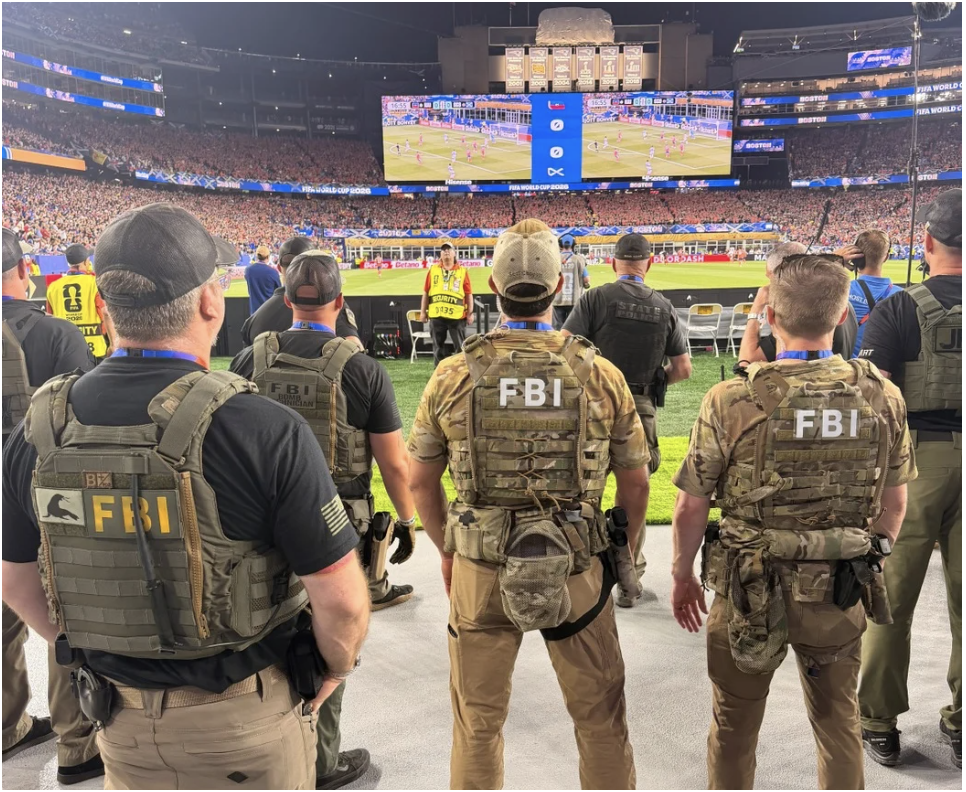
According to the FBI, once a special event begins, the Bureau shifts from prevention posture to real-time readiness. Specialized personnel — including bomb technicians, drone detection teams, tactical ground teams, aviation teams, hostage negotiators, communication specialists, and explosive-detecting dogs — are prepositioned at or near venues. Command post communication is tested continuously. Intelligence is shared in real time with local, state, and federal partners.
Many of the personnel working under the FBI’s banner during World Cup matches were members of FBI joint task forces and were federally deputized, giving them federal authority alongside their state or local law enforcement authority. That coordination allowed for immediate response to concerns like unattended bags, threatening social media posts, or other real-time developments.
Concerns from civil liberties advocates
Civil liberties groups raised concerns about the size and scope of the federal security footprint at the World Cup. The American Civil Liberties Union issued a travel advisory before the tournament warning fans about potential immigration enforcement in host cities. Local host committee leaders and federal officials have said the security operation is focused on identifying and responding to genuine threats, not on broad immigration enforcement at match sites. Both sides of the conversation exist, and Texans traveling to matches this weekend should be aware of both.
The goal: for you to never notice
Here’s the honest read, neighbor. The whole point of every one of these security operations — the IPCC in Houston, the 25 agencies coordinating in Dallas, the counter-drone teams, the intelligence sharing, the specialized units prepositioned at every venue — is for none of us to notice any of it. If you attended a match at AT&T Stadium or Houston Stadium and had a great time and went home safely, that’s the operation working.
“Ideally, fans and participants will never know the FBI is present at an event,” Kurt Taves, an assistant special agent in charge in the FBI Miami Field Office, said. “We want to be bored on game day. We want the excitement to be on the pitch.”
Enjoy the weekend, neighbor
The World Cup wraps Sunday, July 19, 2026. For 39 days, Texas has been at the center of one of the largest, most complex security operations in American history. And for 39 days, the vast majority of us have simply gotten to enjoy the games. That’s not an accident. That’s the work of the FBI, DHS, the Secret Service, Texas DPS, Dallas PD, Houston PD, the Harris County Sheriff’s Office, dozens of federal task forces, and thousands of people who spent months and years making sure nothing went wrong.
To all of them: thank you. And to the rest of us: enjoy the final matches, take the family to a watch party, and cheer loud. It’s the last weekend of a tournament we’ll be talking about for decades.
If you’re heading out this weekend
If you’re heading to a final-weekend event and see something that doesn’t look right, don’t hesitate. Report suspicious activity to the FBI at 1-800-CALL-FBI (1-800-225-5324) or online at tips.fbi.gov. Tips can be submitted anonymously. For emergencies, call 911.
The FBI recommends that anybody attending a large public event pay attention to their surroundings, locate the exits before the event begins, and identify where law enforcement officers are stationed. If something feels off, trust that instinct.
The final matches wrap Sunday, July 19, 2026. See you at the watch parties, neighbor.
Sources: Federal Bureau of Investigation; FBI Houston Field Office; City of Dallas; Houston Host Committee; Office of the Governor of Texas