
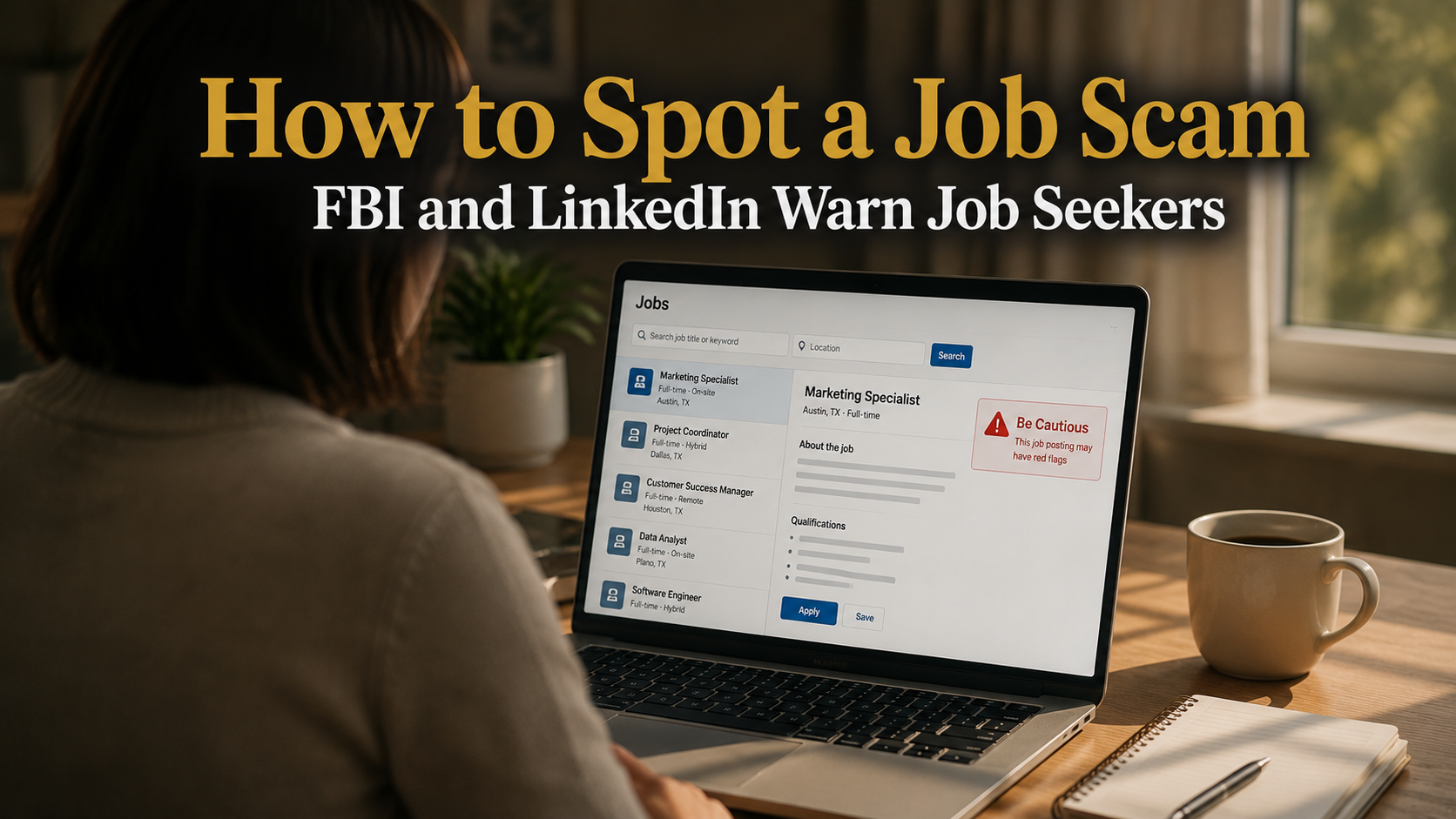
Employment scams cost Americans nearly $363 million in 2025 alone, and the FBI says most aren’t just after your money — they’re recruiting money mules, harvesting identities, or luring people into overseas forced-labor scam compounds. Here’s what to watch for
FBI and LinkedIn joint public education campaign. Employment scam red flags and reporting information at fbi.gov/scams. Video from the campaign available at fbi.gov.
Well neighbor, if you or somebody you love has been on the job market lately — or is just active on LinkedIn — this is a piece worth reading all the way through. The FBI and LinkedIn have teamed up on a joint public education campaign to help job seekers recognize the warning signs of employment scams before they get pulled in. And the reality of what these scams have become is more alarming than most people realize. It’s not just about lost money anymore. It’s about identity theft, criminal exploitation, and in some of the worst cases, human trafficking.
Here’s what the FBI and LinkedIn want every job seeker to know.
The scale of the problem
According to the FBI, its Internet Crime Complaint Center received 24,688 reports of employment scam victimization in 2025, with nearly $363 million in reported losses. Employment fraud now ranks 10th among all types of internet crime the FBI tracks, both by number of complaints and by estimated losses.
LinkedIn, the world’s largest professional network, has more than 1.3 billion members in over 200 countries. According to the company, roughly 10,000 job applications are submitted every minute on the platform. That volume alone shows why the FBI and LinkedIn decided a joint educational push was necessary — scammers know that’s where the job seekers are, and they’ve become more sophisticated about blending in.
“Job seekers are uniquely vulnerable — not because they lack judgement but because they’re operating in an environment where urgency and opportunity are constant,” Rebecca L. Keithley, assistant section chief of the Financial Crimes Section in the FBI’s Criminal Division, said. “The goal isn’t just to respond after someone becomes a victim but to help people recognize the warning signs early enough to avoid the scam entirely.”
Three main types of employment scams — and none are quite what you’d expect
Here’s the part the FBI really wants job seekers to understand. Most employment scams today aren’t just about stealing your money directly. According to the Financial Crimes Section, they’re run for one of three main purposes:
Money mule recruitment. The scammer’s actual goal is to use your bank account to move stolen money. The “job” gets a legitimate-sounding title like “cryptocurrency transaction specialist,” “accounts receivable assistant,” “remote financial coordinator,” or “payment processing agent.” Money — usually stolen from other victims — is deposited into your account. You’re told to withdraw it, convert it to cash, gift cards, or cryptocurrency, and forward it elsewhere in exchange for a small commission. You aren’t just being scammed — you’re unwittingly laundering criminal proceeds, and the FBI warns you can face real legal consequences, including having your accounts closed and your funds seized.
Personal identity harvesting. Same trick, different target. The “job” carries titles like “onboarding specialist,” “HR assistant,” “compliance reviewer,” or “know your customer/identity verification agent.” Once “hired,” you’re asked to collect and forward identity documents, log into portals, handle one-time verification codes, open accounts, or upload files to shared drives. What’s really happening: you’re helping the scammers steal other people’s identities. You become their unpaid data-processing worker.
Human trafficking and forced labor. This is the darkest of the three, and it’s growing. The pitch is high pay for vague duties, often overseas, with the recruiter offering to handle flights and visas. When the victim arrives, their passport is confiscated, they’re told they owe money for their travel, and they’re forced into “scam compounds” — often in Southeast Asia — where they’re required to run scams against other victims. The FBI says victims are monitored, threatened, and sometimes physically abused if they fail to meet quotas.
“Some of these scammers don’t just take money, they take control. What starts as a job offer can end in coercion, isolation, and forced criminal activity,” Keithley said. “We’re confronting industrial-scale fraud operations where trafficked individuals are forced to perpetrate scams under coercion and abuse. It’s exploitation layered on top of exploitation.”
How LinkedIn is fighting back
According to LinkedIn, the company uses a combination of automated systems and human oversight to detect and remove scam content. The company says 98.7 percent of detected spam and scam content is removed by automated defenses before members ever see it, and 99.5 percent of detected fake accounts are stopped proactively.
The platform also uses a verification system that displays an icon when identifying information about a person or company has been confirmed, giving job seekers a signal about who they’re actually engaging with.
“Trust is really at the core of everything we do at LinkedIn,” Oscar Rodriguez, vice president of trust at LinkedIn, said. “The shift we’re seeing now is that bad actors are becoming more sophisticated.”
Artificial intelligence, Rodriguez noted, has made the scammers’ work easier. “It makes it cheaper, faster, and more scalable to pretend to be someone you are not.” He added: “This is not a problem that any one company can solve on its own.”
LinkedIn’s number one red flag
According to Rodriguez, the single clearest warning sign that a job offer on LinkedIn might not be legitimate is this: the recruiter or company representative tries to move the conversation off of LinkedIn’s messaging platform. Scammers move to WhatsApp, Telegram, or personal email to avoid LinkedIn’s built-in fraud protections and reporting tools. If somebody offering you a job pushes you to switch to an encrypted messaging app early in the conversation, that’s a serious red flag.
Red flags for money mule scams
The FBI says be especially alert if a new job asks you to do any of the following:
Use your personal bank account for business transactions.
Skip normal payroll systems that a legitimate employer would use.
Move money quickly or keep transactions “confidential.”
Accept wages tied to moving money rather than doing actual work.
Open new bank accounts or use cryptocurrency or gift cards to move funds.
Red flags for identity-theft scams
For identity-harvesting scams, the FBI says watch for these signs:
You’re asked to handle other people’s IDs or Social Security numbers as a contractor without a real HR or compliance infrastructure in place.
Files are being sent via email, Telegram, WhatsApp, or Google Drive links rather than through secure company systems.
You’re told to verify identities manually instead of using a formal, established system.
The company can’t clearly explain why you need access to other people’s personal information.
You’re pressured to move fast or bypass normal safeguards.
Red flags for human trafficking and forced labor scams
For the most dangerous category, the FBI says these signs should stop you immediately:
The job offers high pay for vague duties, especially overseas.
The employer insists on quick relocation.
The employer controls or “assists” with all travel logistics — flights, visas, everything.
Contracts are vague, or change after you arrive.
Communication shifts to encrypted apps early in the process.
You’re told not to involve family or others in the process.
Any of these — but especially the last one — is a serious warning that this is not a legitimate job.
What to do if something feels wrong
Here’s the FBI’s core message, and it’s worth repeating. The most effective disruption point for a scam isn’t after you’ve lost money — it’s before you take the first step. If something in a job posting or a recruiter’s message feels off, trust that instinct. Research the company independently. Look up whether the recruiter has real, verifiable connections to the company. Search for the job listing on other platforms to see whether it appears elsewhere. Ask questions a real employer would expect and answer.
If you’ve been targeted or victimized by an employment scam, report it to the FBI’s Internet Crime Complaint Center at ic3.gov. On LinkedIn, you can also report suspicious accounts and messages directly through the platform. And to learn more about scam warning signs and reporting, visit fbi.gov/scams.
Watch the FBI and LinkedIn video
The FBI and LinkedIn have released a joint video walking through employment scam red flags and how to spot them. Watch the full video at fbi.gov/scams.
Why this matters
Here’s the honest read, neighbor. Nearly $363 million lost in a single year — from a single category of scam that most people don’t even know exists in the forms it now takes. Your paycheck. Your identity. In the worst cases, your freedom. The scammers know how to blend in. They know how to sound professional. They know how to build trust before they exploit it. The FBI and LinkedIn are trying to level the playing field by getting the warning signs into the hands of job seekers themselves. Read them. Share them with the young people in your life who are just entering the job market. Share them with the recent graduate, the military veteran transitioning to civilian work, the friend who got laid off last month. This is the kind of information that quietly saves people.
The tools are simple. Trust your instincts. Verify independently. Never move off a platform to encrypted apps at a recruiter’s request. Never use your personal bank account or crypto wallet for a new employer. Never accept a job offer with vague duties and expensive overseas travel handled by strangers. And if something feels wrong, walk away.
For more information and to watch the joint FBI–LinkedIn video, visit fbi.gov/scams.
Stay safe out there, neighbor. And keep looking for the real opportunity — it’s out there.