James Webb Telescope Observes Ancient Supernova Repeat Three Times — Challenging Our Understanding of the Universe
The James Webb Space Telescope has focused on an ancient supernova, uncovering new evidence that the ongoing "Hubble tension" in cosmology remains unresolved.
The James Webb Space Telescope (JWST) has unveiled new evidence suggesting that our understanding of the universe may be flawed, intensifying a crisis in cosmology known as the “Hubble tension.”
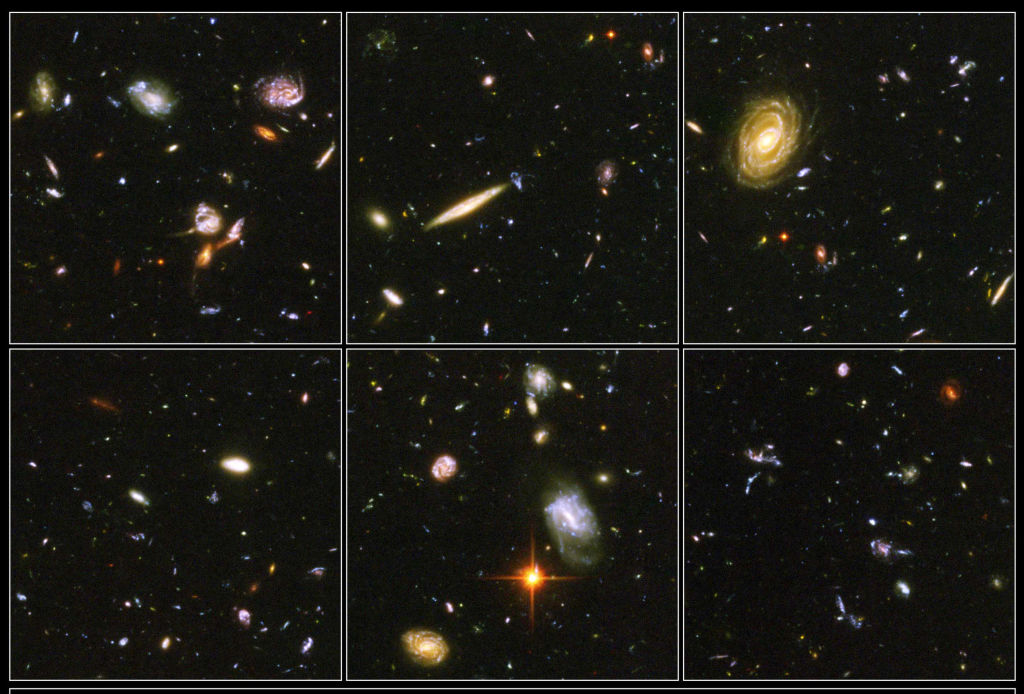
IN SPACE: In this NASA handout, a view of deepest view of the visible universe ever achieved are seen in a Hubble Telescope composite photograph released March 9, 2004. The Hubble Ultra Deep Field (HUDF) photograph is a composite of a million one-second exposures and reveals galaxies from the time shortly after the big bang. (Photo by NASA/Getty Images)
This tension arises from conflicting measurements of the universe’s expansion rate, or the Hubble constant. When astronomers measure the rate in different regions, they come up with varying results. The JWST’s latest observation of a supernova 10.2 billion light-years away highlights the persistence of this mystery, confirming that the issue is far from resolved. The findings, published in The Astrophysical Journal and the pre-print database arXiv, show that the universe might not be expanding uniformly as our models predict.
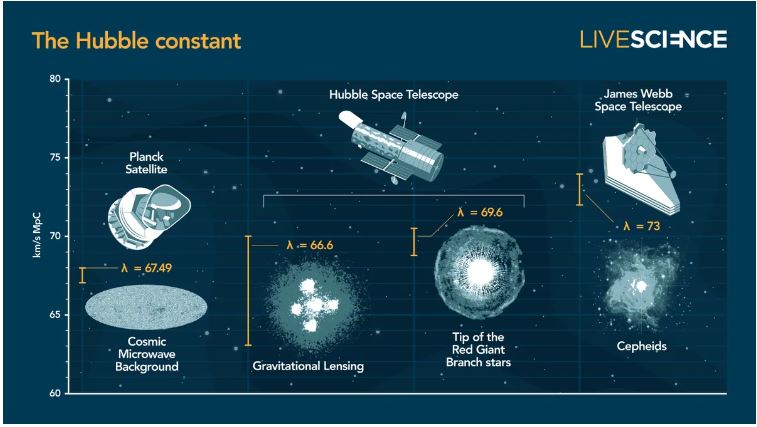
A collection of some of the most recent measurements of the Hubble constant. From left to right, the sources used to measure its value are: The cosmic microwave background images by the European Space Agency’s Planck satellite; gravitational lensing and tip of the Red Giant Branch stars measured by NASA’s Hubble space telescope; and cepheid stars measured by the James Webb space telescope (Image credit: Future)
One of the study’s co-authors, Brenda Frye, an associate professor of astronomy at the University of Arizona, emphasized the importance of these results, noting that the Hubble constant measurements from the local universe conflict with those derived from when the universe was much younger.
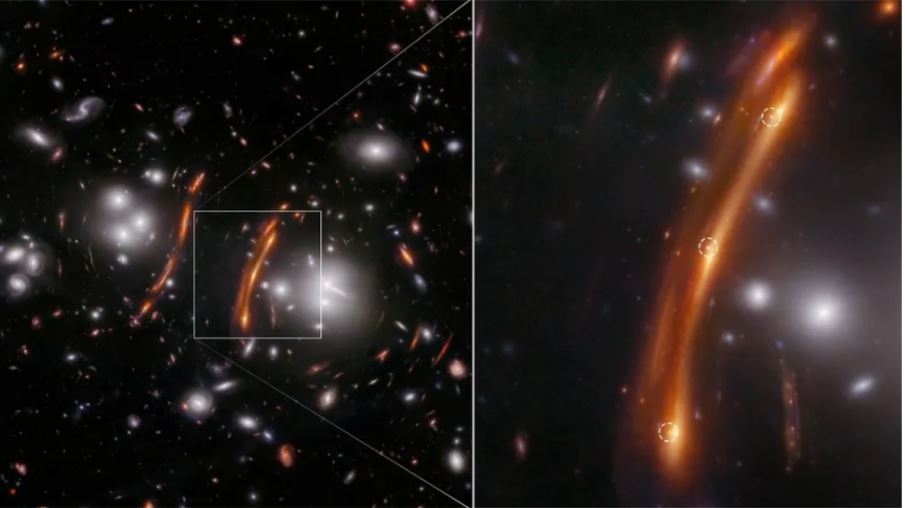
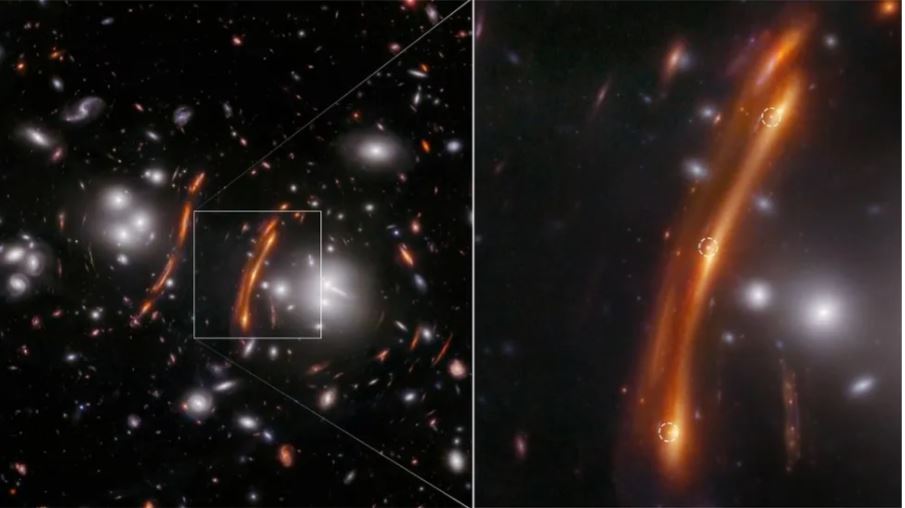
An ancient supernova from the early universe is magnified and duplicated three times (circled dots) through the phenomenon of gravitational lensing. (Image credit: NASA, ESA, CSA, STScI, B. Frye (University of Arizona), R. Windhorst (Arizona State University), S. Cohen (Arizona State University), J. D’Silva (University of Western Australia, Perth), A. Koekemoer (Space Telescope Science Institute), J. Summers (Arizona State University).)
The two primary methods for calculating the Hubble constant both produce different results. The first relies on studying the cosmic microwave background (CMB), the ancient afterglow of the Big Bang, which suggests an expansion rate of 67 km/s/Mpc, aligning with our current cosmological models. However, the second method, which uses Cepheid variable stars in the nearby universe, provides a higher rate of 73.2 km/s/Mpc. While the difference may seem small, it contradicts the standard model, which posits that dark energy should be driving the expansion at a consistent rate.
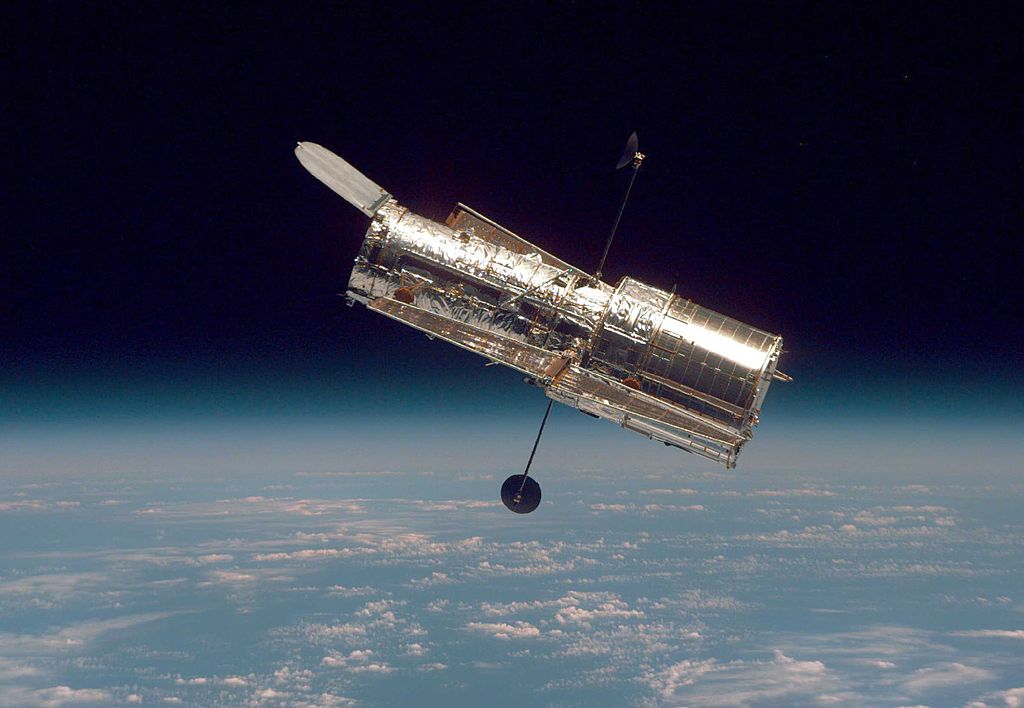
IN SPACE: (FILE PHOTO) In this handout from the National Aeronautical Space Administration (NASA), the Hubble Space Telescope drifts through space in a picture taken from the Space Shuttle Discovery during Hubble?s second servicing mission in 1997. NASA annouced October 31, 2006 that hte space agency would send a space shuttle to the Hubble Telescope for a fifth repair mission no earlier than May of 2008. (Photo by NASA via Getty Images)
These latest findings from the JWST suggest that there’s still much we don’t understand about the forces shaping the cosmos, and solving the Hubble tension could have profound implications for our understanding of the universe’s fate.
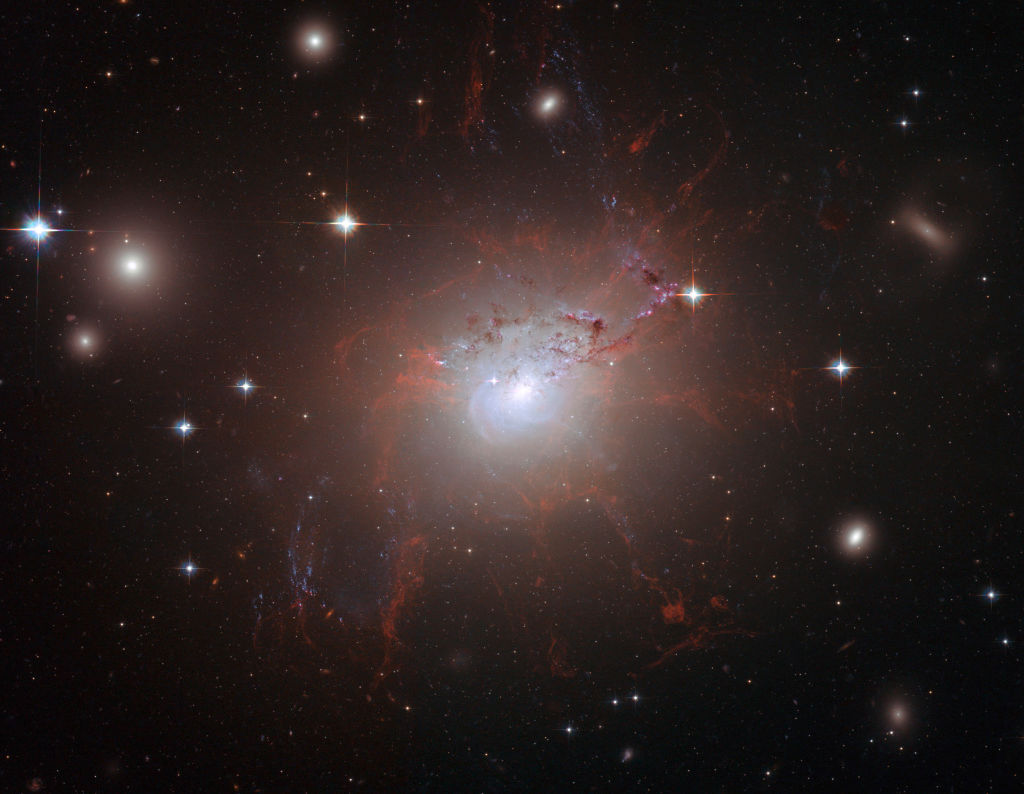
IN SAPCE – UNDATED: This handout image of the giant, active galaxy NGC 1275, obtained August 21, 2008 was taken using the NASA/ESA Hubble Space Telescope?s Advanced Camera for Surveys in July and August 2006. It provides amazing detail and resolution of fragile filamentary structures, which show up as a reddish lacy structure surrounding the central bright galaxy. These filaments are cool despite being surrounded by gas that is around 55 million ?C. They are suspended in a magnetic field which maintains their structure and demonstrates how energy from the supermassive black hole hosted at the centre of the galaxy is transferred to the surrounding gas. (Photo by NASA/ESA via Getty Images)
As a native Texan, I am passionate about covering the news that impacts our lives in Texas. Community and family is what is important at the Texas Insider, we strive to deliver comprehensive stories by examining history and presenting the full picture.