
Harris County just landed the biggest pharmaceutical manufacturing deal in Texas history.
Eli Lilly and Company announced it will pour more than $6.5 billion into building a massive drug manufacturing facility at Generation Park. The nearly 1 million square foot plant will create over 600 new jobs and produce the raw ingredients for next-generation medicines right here in Texas.
This marks the largest investment in pharmaceutical ingredient manufacturing the state has ever seen—and it means Texas takes another step away from relying on foreign countries for critical medicines.
What Lilly Makes
Eli Lilly has been making medicines since 1876, when Civil War veteran Colonel Eli Lilly opened a tiny pharmacy in Indianapolis with just three employees. Today, the company produces some of the world’s most important medications.
You might know their products: Mounjaro and Zepbound for diabetes and weight loss, Prozac for depression, insulin medications that have saved countless lives, and treatments for cancer, Alzheimer’s, and ulcerative colitis. The company pioneered insulin production in the 1920s, mass-produced penicillin during World War II, and helped manufacture most of America’s polio vaccine supply in the 1950s.
Now they’re bringing that expertise—and billions in investment—to Harris County.
What This Means for Texas
The new Harris County facility will focus on making active pharmaceutical ingredients (APIs)—the actual chemical compounds that make medicines work. Right now, America depends heavily on other countries for these critical materials. When supply chains break down, people can’t get the medications they need.
This plant changes that equation. Texas will produce ingredients for cutting-edge small molecule synthetic medicines domestically, strengthening America’s pharmaceutical independence.
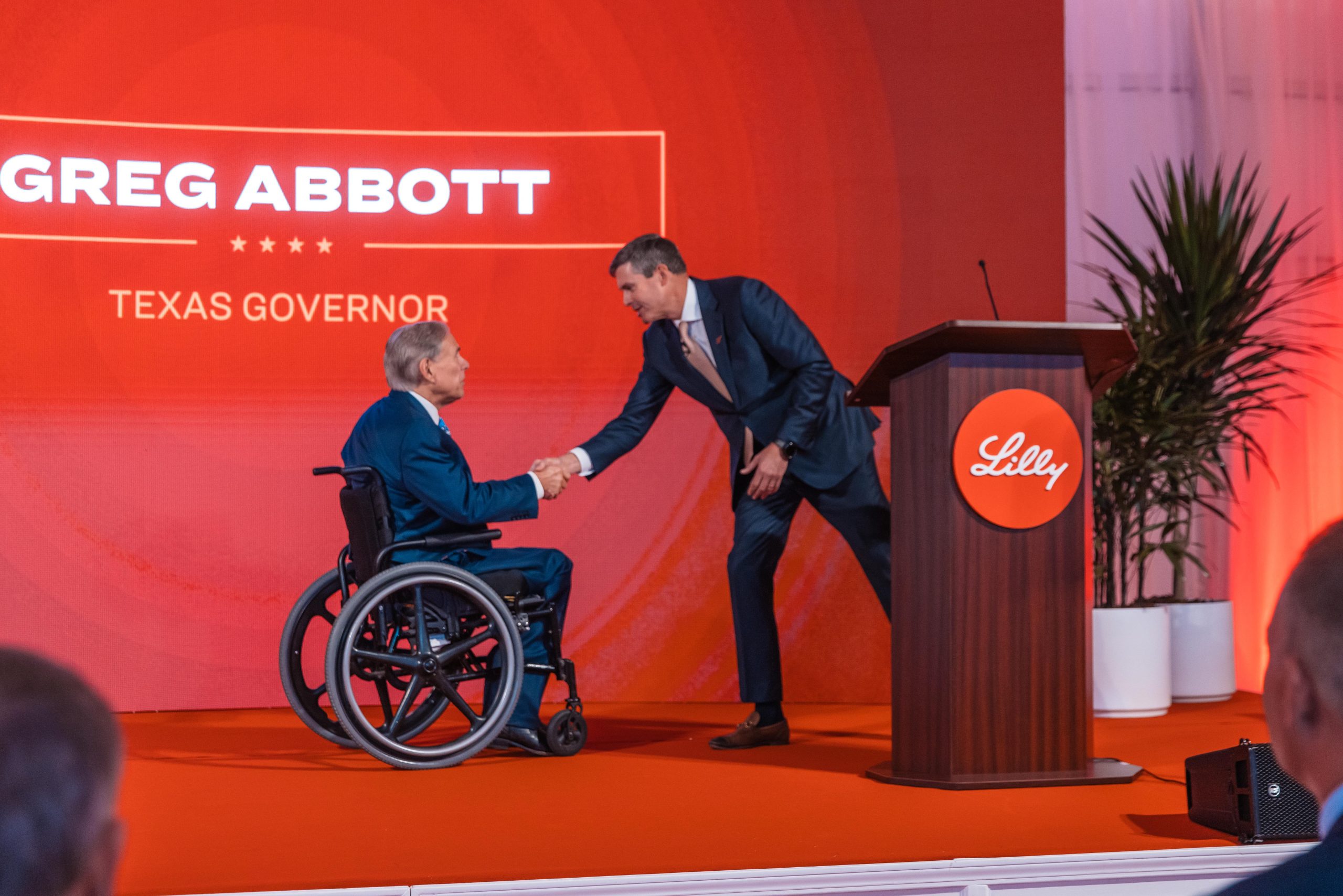
Governor Greg Abbott made the state’s position clear: “This announcement by Lilly will boost pharmaceutical manufacturing in the state of Texas and ensure that we do not rely on other countries for the manufacturing and supply of medicines and medical supplies.”
The investment goes beyond what Lilly originally committed when they first applied for state incentives. Texas offered a $5.5 million grant through the Texas Enterprise Fund, and the project earned approval under the state’s Jobs, Energy, Technology, and Innovation program.
Why Harris County Won
Harris County beat out competing locations across the country for this project. The region offered everything a pharmaceutical giant needs: world-class infrastructure, skilled workers, San Jacinto College partnerships for workforce training, and lightning-fast speed to market.
“Harris County is unmatched for its speed to market, world-class infrastructure, and exceptional workforce,” said Harris County Commissioner Rodney Ellis. “We’ve built an ecosystem purposefully designed for life science projects.”
The Greater Houston Partnership called it “one of the largest for-profit life sciences investments in Texas history” and a sign that Houston is becoming a global hub for biomedical innovation and advanced manufacturing.
Lilly CEO David A. Ricks emphasized what the facility means beyond just business numbers: “Our new U.S. manufacturing facilities are more than just an investment in infrastructure—they’re a commitment to American innovation, onshoring jobs, economic growth, and public health.”
What This Means for Houston’s Medical Center
Houston already operates the largest medical complex in the world—the Texas Medical Center spans 1,345 acres with 61 institutions, 21 hospitals, and employs over 106,000 people. Houston Methodist Hospital ranks as the number one hospital in Texas for 14 consecutive years. MD Anderson Cancer Center has been ranked the nation’s top cancer hospital for 11 straight years.
But Houston has been missing one critical piece: massive pharmaceutical manufacturing.
The Lilly facility completes the ecosystem. Now Houston has world-class hospitals, cutting-edge research institutions, top medical schools, AND pharmaceutical production all in one region. Discoveries made at MD Anderson or Baylor College of Medicine can now be manufactured locally, accelerating the path from lab to patient.
This positions Houston’s Texas Medical Center to compete directly with Boston, San Francisco, and North Carolina’s Research Triangle as a complete life sciences hub—not just excellent at patient care and research, but capable of bringing medicines to market.
What This Means for Texas
This marks Texas’s first major pharmaceutical manufacturing facility investment—a game-changer for the entire state.
Texas already employs over 116,000 people in life sciences, earning an average of $100,000 annually. The industry grew 15% between 2018-2021, outpacing national growth. The sector supports nearly 99,000 direct jobs and 306,000 indirect jobs, with an estimated economic impact of $75 billion.
But Texas has been missing large-scale drug manufacturing. The state excels at discovering medicines and treating patients—now it can produce the actual drugs too.
Between 2018-2021, Texas brought over 5,300 patents to market, including 2,709 for surgical and medical devices, 1,014 for pharmaceuticals, and 508 for biochemicals. Those pharmaceutical discoveries can now be manufactured in-state, creating a complete research-to-market pipeline.
The numbers tell the growth story. Bioscience venture capital investments in Texas jumped from $622.3 million in 2018 to $2 billion in 2021. Recent years have drawn companies from across the country—Cellipont Bioservices from California, Sino Biological from China, PackGene from Massachusetts—all relocating to Texas.
Lilly’s $6.5 billion commitment sends a clear signal: Texas is serious about life sciences. Expect more companies to follow.
National Security Matters Too
During COVID-19, America’s dependence on foreign pharmaceutical manufacturing became a critical vulnerability. Medicine shortages threatened lives because we couldn’t make drugs domestically fast enough.
Texas producing active pharmaceutical ingredients on American soil strengthens national security. When supply chains break down or international tensions rise, Americans need access to life-saving medicines made at home.
The facility addresses that gap head-on.
What’s Next
Construction on the Generation Park facility will create thousands of temporary jobs. Once operational, the plant will employ over 600 people in high-skilled manufacturing positions making living wages, plus thousands more in supporting roles—logistics, quality control, suppliers.
Local school districts are already preparing. Sheldon Independent School District Superintendent Dr. Demetrius McCall called it “a transformative moment” and pledged to partner with Lilly to train students for the advanced manufacturing careers the plant will create. Community colleges across the region will launch pharmaceutical manufacturing training programs to feed the workforce pipeline.
The facility will strengthen domestic medicine supply chains, accelerate delivery of life-changing treatments to patients, and cement Texas as a pharmaceutical manufacturing powerhouse competing with any state in the nation.
For patients across America, it means more reliable access to critical medications. For Texas workers, it means hundreds of good-paying jobs and thousands of supporting positions. For Harris County, it means billions in investment. For Houston, it completes the medical ecosystem. For Texas, it establishes pharmaceutical manufacturing independence.
The pill factory is coming to Texas—and it changes everything.
By the Numbers
Investment: $6.5+ billion
Facility Size: Nearly 1 million square feet
Jobs Created: 600+
State Incentive: $5.5 million Texas Enterprise Fund grant
Location: Generation Park, Harris County
Focus: Active pharmaceutical ingredient (API) manufacturing for small molecule synthetic medicines