
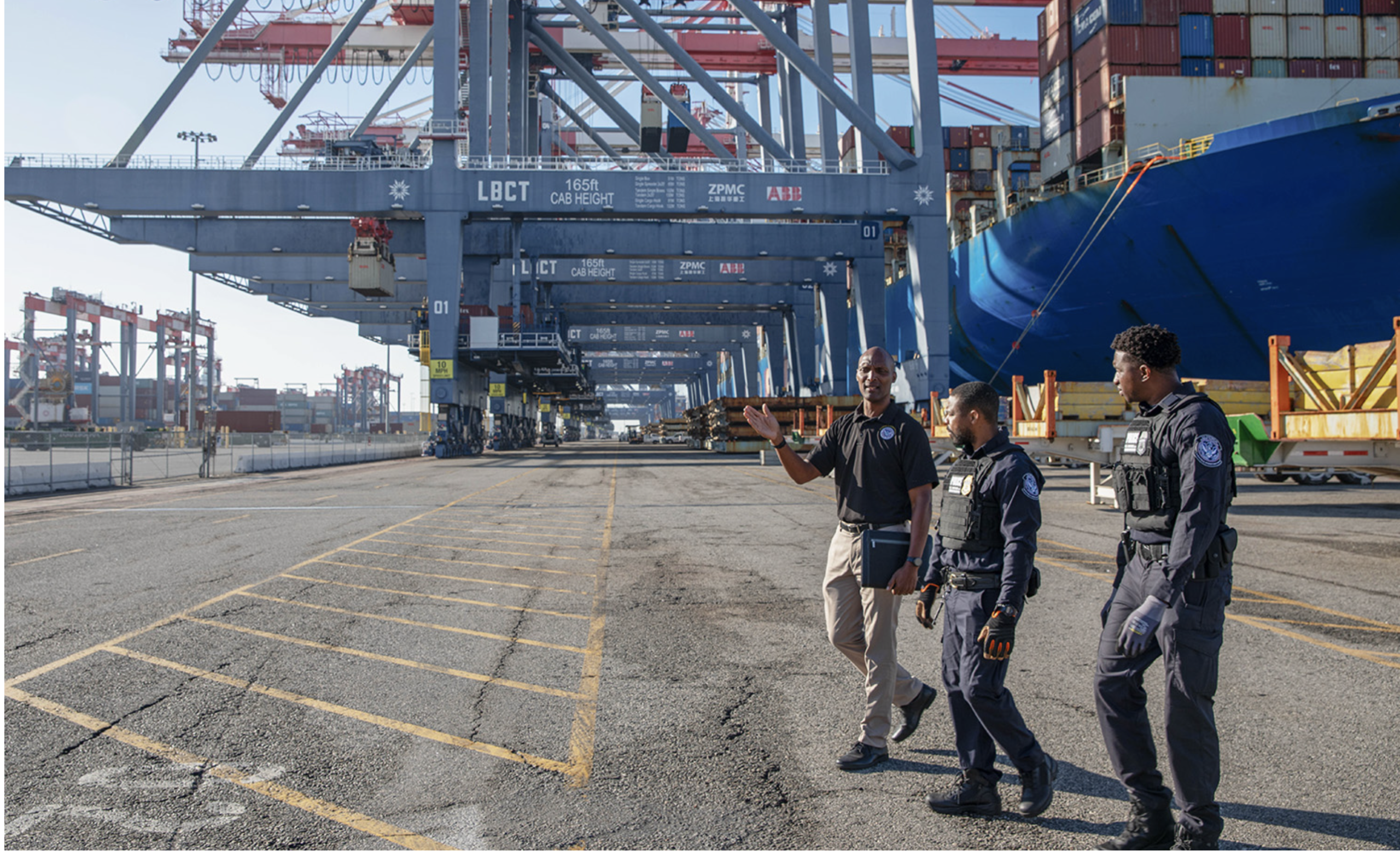
Most people picture Customs officers checking passports. But the agency’s trade specialists — including teams working Texas ports like Pharr and DFW — pulled in more than $216 billion last year and have a knack for sniffing out duty-dodging tricks
Here’s a side of Customs and Border Protection most folks never think about. When you picture CBP, you probably imagine an officer checking travelers at the airport. But there’s a whole other mission humming along at ports across Texas and the country — and it’s one of the biggest moneymakers in the entire federal government.
According to CBP, the agency collected more than $216 billion in total trade revenue in fiscal year 2025, making it the government’s second-biggest revenue generator behind only the IRS. And this isn’t new. CBP’s legacy agency, the U.S. Customs Service, was created by the Fifth Act of Congress back in 1789, and for the country’s first 125 years — until the income tax arrived in 1913 — customs duties essentially bankrolled the entire federal government.
CBP says those early duties helped pay off Revolutionary War debt, finance the Louisiana Purchase, fund the Lewis and Clark Expedition, and even help build Washington, D.C. itself. Not a bad track record for a job hardly anyone notices.
The $34 Million Catch
So how does the modern version work? The agency points to a case from early last year that shows its specialists in action. A major consumer-products company imported electronic household devices, first declaring them as made in China and paying the required duties — then filed a correction switching the country of origin to Mexico, which would have made the goods duty-free under the U.S.-Mexico-Canada trade agreement, and asked for a refund.
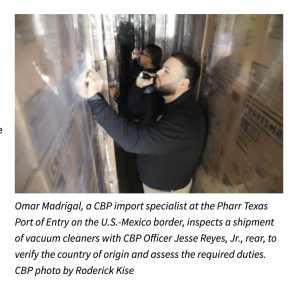
CBP flagged the shipment for review. According to import specialist Omar Madrigal, who works at the Pharr Port of Entry on the Texas-Mexico border, one photo the company submitted showed the product was actually marked “Made in China” — a red flag. The agency dug into where the raw materials came from and applied what are called “rules of origin.” The key question, CBP explains, is whether a product was “substantially transformed” in a country. Supervisory import specialist Mary Freeman offered a simple way to think about it: Italian flour shipped to Mexico and turned into spaghetti becomes Mexican spaghetti — a real transformation. But the electronics were merely assembled in Mexico from Chinese parts, with no such transformation. The result: the company owed more, not less. CBP collected $34 million.
The agency is quick to say it isn’t out to punish honest mistakes. “CBP is fair and reasonable in our enforcement of tariffs and trade,” said Lori Whitehurst, director of trade operations for CBP’s Office of Field Operations, who said the agency goes after companies deliberately trying to evade duties, not those who own up to an error.
The Tricks of the Trade
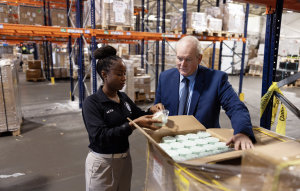
CBP says duty-dodgers get creative, and the agency walked through a few of the most common schemes.
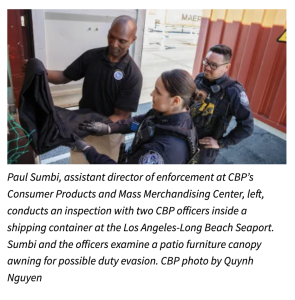
One is simply undervaluing goods. The agency points to an August 2025 case at Dallas-Fort Worth International Airport, where 12 watches arrived by express courier declared at about $500 each. An officer suspected they were worth far more and detained them. They turned out to be designer Swiss watches worth over $1.9 million. According to CBP’s Paul Sumbi, the buyer ended up paying $21,000 in duties to retrieve them, plus tens of thousands more in unpaid duties from past shipments and a six-figure penalty.
Another trick is misclassification — and CBP shared one of the stranger examples. At a Florida port, officers flagged a shipment of plastic food containers labeled as household goods, even though they were arriving by the thousands and invoices showed they were headed to fast-food chains. Oddly, the “household” label actually carried a higher duty rate than the commercial one. The real reason, CBP says, became clear once specialists realized the commercial containers from China carried an extra 25% duty the company was trying to hide. The importer ended up owing an additional $50 million, and several related companies owed nearly $39 million more.
Chasing Mattresses Across the World
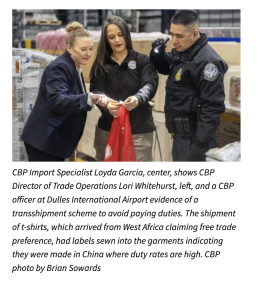
The most eye-popping case CBP describes involves illegal transshipment — routing goods through a third country to disguise where they were really made. In 2024, import specialist Sonna McWilliams noticed a company that had long claimed China as the origin of its mattresses suddenly switching to Singapore.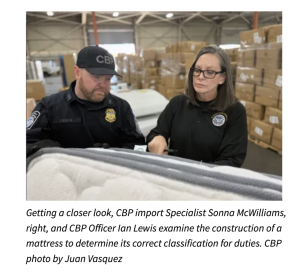
That mattered because, to protect U.S. manufacturers, CBP says an enormous additional tariff had been placed on Chinese-made mattresses. McWilliams suspected the mattresses weren’t really Singaporean. CBP officers stationed in Singapore — part of the agency’s Container Security Initiative — helped confirm it. According to CBP officer Michael Pasko, the shipments made no economic sense: mattresses were being unloaded in Singapore, warehoused briefly, then reloaded for the U.S. at real cost, and shipments from Singapore had ballooned 8,000% over a decade in a country with little room to manufacture them. A site visit found a factory that was only assembling, not making, the mattresses. The importer was ultimately required to pay the U.S. government $361.4 million in duties.
A Global Team Effort
CBP also credits its partnerships with customs agencies abroad. The agency describes a May 2025 case in which the Korean Customs Service asked for help determining whether two Korean manufacturers were falsely claiming Korea’s free trade agreement on jewelry actually made in China and Vietnam. A CBP specialist compared the paperwork — sometimes written in Chinese or Vietnamese — and matched shipments by weight. According to CBP, the two manufacturers were arrested in August 2025, after a joint investigation found they had illegally transshipped more than 1,100 kilograms of jewelry valued at an estimated $53.2 million.
Why It Matters
The through-line, CBP says, is that the trade mission protects more than just government revenue — it keeps American companies competing on a level field. “When most people hear about CBP, they think of officers checking travelers coming from overseas,” said center director Melvin Moreland, who said the agency’s trade work ensures imports are properly described, meet safety rules, and carry the right duties so domestic companies can compete fairly.
And every dollar collected, Whitehurst noted, goes to the U.S. Treasury rather than to the agency itself. “It goes to the nation,” she said. For an operation most travelers never see, it’s a reminder that a lot of the work at America’s ports — including right here in Texas — happens far from the passport line.