

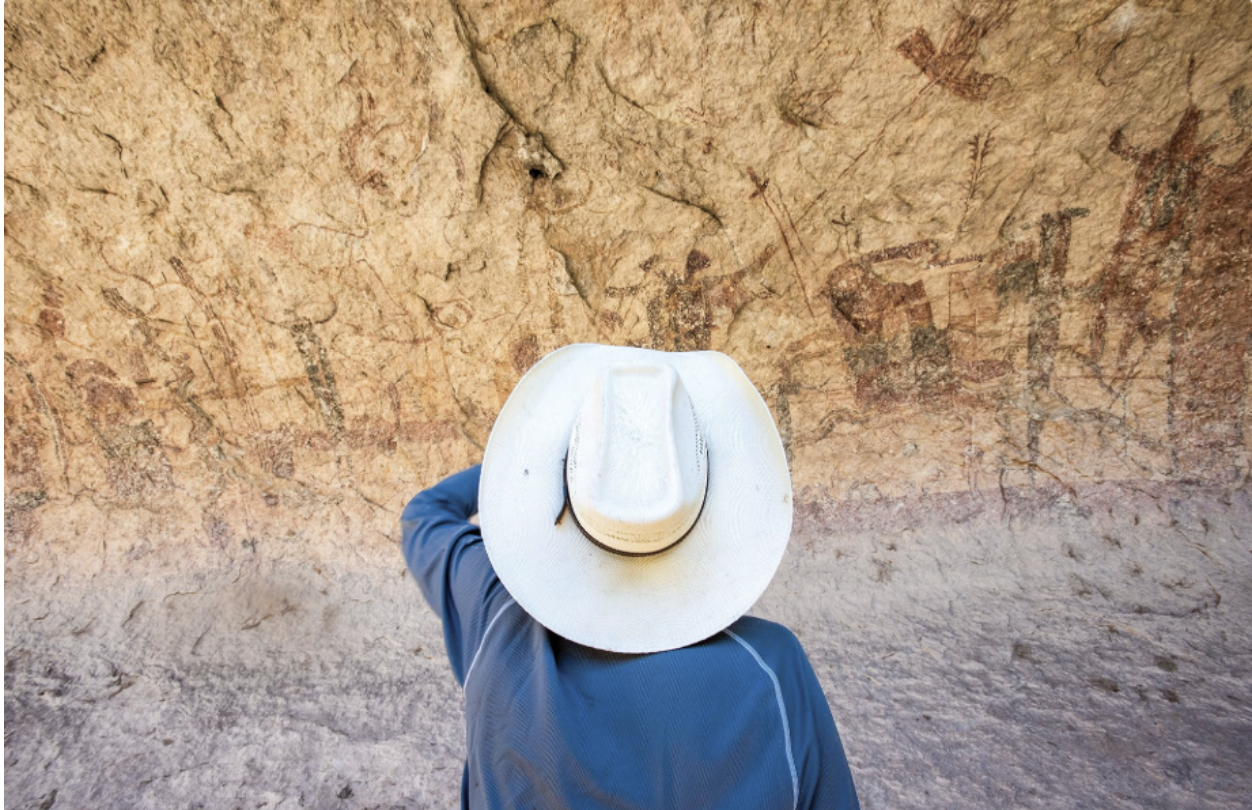
If someone handed you the oldest known book in North America, what would you do with it? You’d treat it reverently, preserve it, study what it says. That’s exactly what these books demand, except they’re not made of paper. They’re Pecos River-style pictographs painted on limestone canyon walls by nomadic hunter-gatherers thousands of years ago.
“These are the first books written in North America,” says Carolyn Boyd, the foremost expert on Lower Pecos canyonlands rock art and an anthropology professor at Texas State University. “The information in these ancient manuscripts is part of the human story. What we are learning from them is truly rewriting the history of our continent.”
And you can see them yourself.
The Breakthrough That Changed Everything
For decades, experts believed the visual narratives of Lower Pecos rock imagery were incomprehensible—beautiful but unreadable. Boyd and her colleagues at the Shumla Archaeological Research and Education Center in Comstock proved them wrong.
Using advanced technologies like high-resolution GigaPan photography, digital microscopy, X-ray fluorescence, and 3D modeling, the Shumla team unlocked secrets that had remained hidden for millennia. Science director Karen Steelman dated some Pecos River murals to 5,500 years old—older than Egypt’s first pyramids. Radiocarbon dating techniques perfected at Shumla revealed that Pecos River-style rock art was produced continuously for more than 4,000 years.
Boyd cracked the code by identifying striking parallels between Pecos River-style art and other Native American iconography, including Aztec codices and the sacred stories of the Huichol people of central-northwest Mexico. When she brought a Huichol shaman to the White Shaman site, he wept and said, “They are all here, all of my ancestors, all of my grandfathers.”
These aren’t just pretty pictures. They’re creation stories, cosmology, belief systems—the deepest thoughts of people who lived here thousands of years before Europeans arrived.
Why You Need to Visit Seminole Canyon
Drive west of Del Rio along U.S. Highway 90 and you’ll enter the Lower Pecos canyonlands. Though harsh and arid, this landscape conceals a painted treasure. More than 350 known pictograph sites lie within a 60-mile radius of where the Pecos River meets the Rio Grande.
Seminole Canyon State Park and Historic Site, 40 miles northwest of Del Rio, packs incredible rock art viewing and adventure into 2,172 acres. Superintendent Craig Howell calls it “a hidden gem. Most people stumble upon it on their way to Big Bend.”
The Fate Bell rock shelter is the Louvre of the Lower Pecos. More than 500 feet wide, this cavernous shelter harbors a remarkable array of pictographs spanning multiple styles and thousands of years.
Tours descend 250 feet along a steep trail to the canyon floor. Your guide points out lechuguilla, sotol, yucca, and other plants that sustained the people of the Pecos for millennia. Inside the Fate Bell Annex rock shelter, you see your first pictographs—Pecos River style, the oldest and most elaborate of the region’s five rock art styles.
Painted in polychrome hues of black, red, yellow, and white, these images include human-like anthropomorphs, animal-like zoomorphs, and enigmatic figures that spark your imagination. The highlight at Fate Bell: a vivid tableau showing a winged, antlered deity encircled by smaller figures in a counterclockwise procession. The elongated, rectangular anthropomorphs with stubby legs and outstretched arms possess both abstract beauty and spiritual power.
Volunteer guide Lance Hildreth gets it right: “When you hear the term hunter-gatherer, it evokes a very simple and primitive people. If you spend time looking at their pictographs, you realize they were complex, deep thinkers. They were very amazing people.”
The White Shaman Experience
The White Shaman mural is tucked in an alcove-like rock shelter perched high on a cliff overlooking the Pecos River. Much smaller and more intimate than Fate Bell, this was a sacred ceremonial site rather than a habitation.
Despite its fame today, the White Shaman wasn’t documented until 1958. San Antonio photographer Jim Zintgraff helped preserve it and coined its evocative name. The Rock Art Foundation protected it for decades before transferring the White Shaman Preserve to the Witte Museum in 2017.
Tours at the 400-acre preserve start early. Director Aimee Spana shows visitors samples of crushed minerals the ancient ones used to create paint—manganese for black, hematite-rich ochre for red, limonite for yellow, and gypsum for white. All sourced locally. They added water and animal fat from deer, plus yucca juice as an emulsifier, creating durable natural oil paint.
Creating paint for hundreds of murals required communal sacrifice. Using calorie-rich animal fat, a precious dietary resource in this harsh environment, underscored how important these murals were. The artists constructed ladders and scaffolds from sotol stalks to paint figures high on shelter walls and ceilings.
Using digital microscopy to study paint layers, Shumla researchers discovered that painters applied colors in a specific order: black (primordial darkness before creation), then red (the horizon’s fiery hue before sunrise), then yellow (the birth of the sun), and finally white (sunlight at its brightest). These four colors appeared in that deliberate order in Pecos River-style murals for thousands of years.
The trail winds through flat upland terrain, past earth ovens and desert plants. At the canyon’s edge, you descend the equivalent of 100 flights of stairs, zigzagging down a steep trail. To reach the White Shaman, you clamber up limestone steps, gripping iron chains.
“The White Shaman is a sacred space,” Spana says as you enter the alcove. “It’s like walking into someone’s church. Please spend the first few minutes in silence and pay homage to the ancestors who painted it.”
The White Shaman—a deity, not actually a shaman—faces west, catching the sun’s last rays. Small at just 26 feet long and 13 feet high, the mural contains infinite complexity: six zoomorphs, 69 enigmatic figures, and 42 anthropomorphs. Some have antlers, some are headless, some are impaled with darts and spears.
It’s a creation story depicting the beginning of time, the birth of the sun, and the cosmology of the people of the Pecos. Boyd’s research in her book “The White Shaman Mural” explains the iconography as an ancient precursor to Mesoamerican civilizations and contemporary Huichol beliefs.
Stand in that alcove long enough, removing your lens of logic and science, and the faceless figures and deities look back at you, alive and present.
What Makes This So Important
Harry Shafer, a 60-year veteran of Lower Pecos archeology, explains it simply: “There’s no other area in North America and Mesoamerica with such an incredible, intense concentration of pictographic rock art. It’s the nature of the landscape—there are canyons upon canyons with protected canvases they could paint on.”
The cultural resources of the Lower Pecos Archaeological District earned designation as a National Historic Landmark in 2021. These are the oldest securely dated pictographs and the longest enduring art tradition with complex narratives in the Americas.
Hundreds of archeological sites were inundated by Amistad Reservoir in the late 1960s, and most surviving murals lie on private land. Today, Shumla, the Witte Museum, Texas State University, Texas Parks and Wildlife Department, the National Park Service, and private landowners collaborate to protect rock art still threatened by erosion, humidity, floods, and vandalism.
Boyd founded Shumla in 1998 to document, protect, and raise awareness of Lower Pecos rock art through research, preservation, and education. The work continues because these ancient manuscripts deserve the same reverence we’d give any priceless book.
How to Visit
Seminole Canyon State Park and Historic Site Tours to Fate Bell rock shelter run during fall, winter, and spring. The tour descends 250 feet to the canyon floor—wear sturdy shoes and bring water. Tours typically run at 10am on Wednesdays and Saturdays, but check ahead for current schedule.
White Shaman Preserve Managed by the Witte Museum in San Antonio. Tours available during fall, winter, and spring. This is a strenuous hike—you’ll descend and ascend the equivalent of 100 flights of stairs. Not recommended for anyone with mobility issues or fear of heights. Reservations required.
Both sites close during summer due to extreme heat. Plan your visit for October through April.
Getting There Seminole Canyon State Park sits 40 miles northwest of Del Rio on U.S. Highway 90. The White Shaman Preserve location is provided when you book your tour.
For tour schedules, reservations, and more information, visit Texas Parks and Wildlife’s website for Seminole Canyon State Park, or contact the Witte Museum for White Shaman Preserve tours.
These ancient books have waited thousands of years. They’ll wait a few more months until you can visit. But don’t wait too long—experiencing North America’s oldest manuscripts painted on limestone canyon walls will change how you think about Texas history, human creativity, and the people who walked this land long before us.