

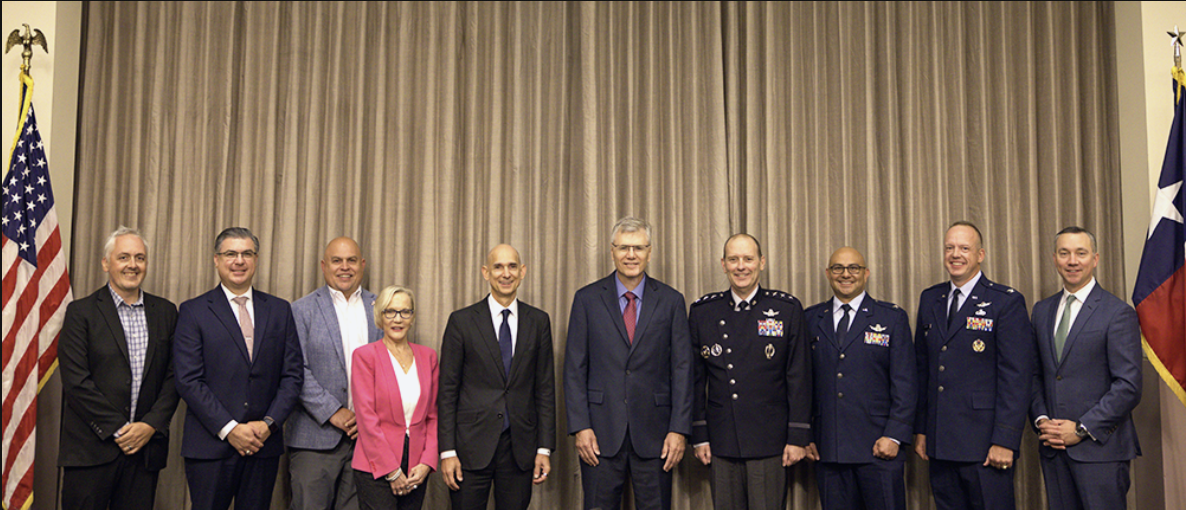
AUSTIN — Texas Governor Greg Abbott announced a new Partnership Intermediary Agreement between the U.S. Air Force Research Laboratory and the Texas Space Commission, creating a federally funded contract worth up to $300 million and running through 2036, according to a statement from the Governor’s office. The agreement will be known as the Texas Space Defense Alliance.
Abbott met with U.S. Air Force Secretary Troy E. Meink in Austin on July 31, 2026, joined by Lt. General Douglas A. Schiess, the U.S. Space Force’s Deputy Chief of Space Operations, along with State Rep. Greg Bonnen and Texas Space Commission board chair Gwen Griffin.
According to the announcement, the agreement is meant to advance spaceflight initiatives in Texas that support U.S. Space Force missions, building an ecosystem for technological and industrial development. The partnership is designed to boost collaboration between academia, commercial partners, and military entities, while helping move new technology toward real-world commercialization. The Texas Space Commission will help the Space Force identify solution providers capable of delivering next-generation operational concepts, research opportunities, and future workforce pipelines.
State Rep. Greg Bonnen, who authored the 2023 legislation creating the Texas Space Commission and chairs the Texas House Committee on Appropriations, said Texas is where the future of American space innovation is being built. He said partnering with the Space Force and Air Force Research Laboratory will let Texas draw on its universities and aerospace industry to speed up next-generation capabilities, strengthen national security, and create new opportunities for Texans.
Through the agreement, the Texas Space Commission will support Space Force tasks across four areas: commercial space strategy, industry partnership, acquisition reform, and industrial base resilience.
Gwen Griffin, chair of the Texas Space Commission Board of Directors, said Texas has built a broad, highly capable space ecosystem, and that the commission is ready to connect that capacity to the Space Force’s most pressing mission needs. She said the partnership will let the commission continue serving as a statewide convener, bringing together universities, established space companies, and government partners to move new technology from concept to reality.
According to the announcement, the agreement creates a streamlined path for technology transfer between federal laboratories and industry and academic partners, allowing military, commercial, and civil space organizations to work together on mission concepts and prototype new capabilities.
The Texas Space Commission is working alongside partners including the University of Texas System and the Texas A&M University System on the initiative. The University of Texas at El Paso and the Texas A&M Engineering Experiment Station have already been identified by the Space Force to help deliver early solutions supporting national defense objectives in space.

The Texas Space Commission was established in 2023 by the 88th Texas Legislature to promote innovation in space operations and commercial aerospace, and to help integrate the space, aeronautics, and aviation industries into the state’s economy. The commission is governed by a nine-member board that also oversees the Space Exploration and Aeronautics Research Fund, a trust held outside the state treasury that provides grants to eligible organizations.