
The Panhandle’s hidden gem is finally opening up—here’s why Cross Bar matters and how you can visit
When Lorie Van Ongevalle’s plane touched down in Amarillo almost 30 years ago, she cried.
“There’s nothing out here,” she thought, unpacking boxes from her Colorado home. As an endurance horseback rider who trains for 50-mile races, she needed long stretches of trail. The flat, dry Panhandle looked like the exact opposite of what she needed.
She was wrong.
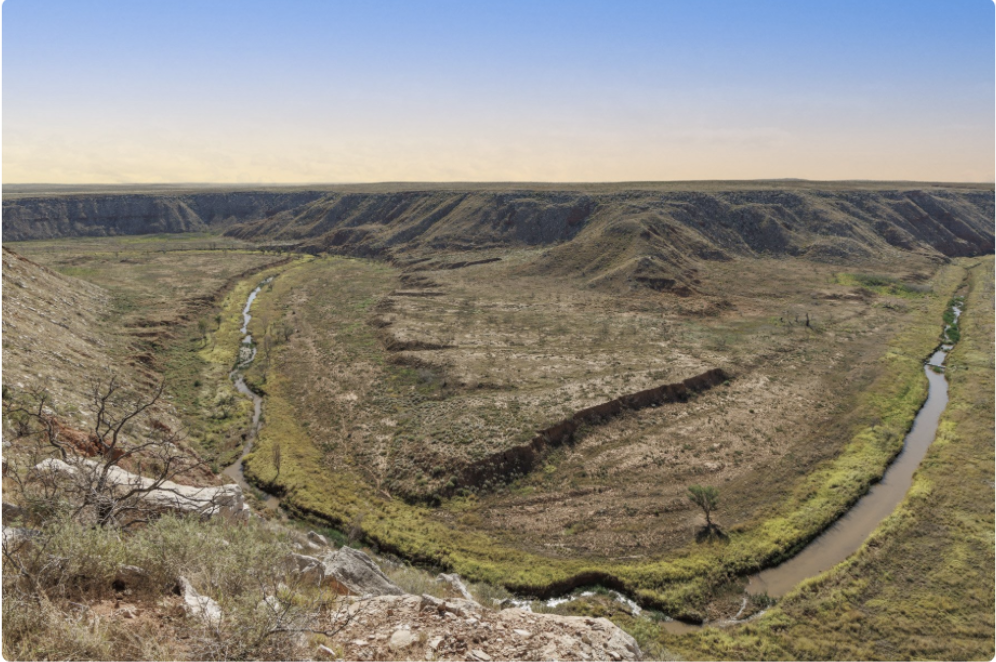
Turns out, there’s a 12,000-acre oasis of public land hiding just 20 minutes north of Amarillo—and it’s the only Bureau of Land Management property in the entire state of Texas. Cross Bar Special Recreation Management Area is home to pronghorn, mule deer, elk, quail, and some of the last remaining virgin shortgrass prairie on the Southern Great Plains.
The catch? For decades, getting there has been nearly impossible.
Why Texas Has Almost No Federal Public Land
Here’s a quick reality check: 97% of Texas is privately owned. While western states like Arizona, Colorado, and California have millions of acres of BLM land open for hiking, camping, and hunting, Texas has exactly one federal tract—Cross Bar.
Why? It goes back to Texas history. When Texas joined the United States, it retained ownership of most of its land, unlike other states. The state then traded that land away for schools, infrastructure, and development projects.
The federal government only acquired Cross Bar during the helium boom of the early 20th century. After World War I, the government invested heavily in helium for blimps and airships. The Panhandle sits atop the Bush Dome reservoir, which held rich stores of helium gas. The feds bought the land in 1931, created the National Helium Reserve, and at peak production supplied 30% of the world’s helium.
After the helium craze died down and wells were plugged, the BLM opened the property for public recreation in the 1990s. But there was one massive problem.
The Access Problem
Cross Bar is essentially an island. It’s surrounded on three sides by private land, bounded on the north by the Canadian River, and on the east by an old train trestle. There’s no public road to get there.
For years, the only way to visit was to:
- Call the BLM field office in Amarillo for a permit
- Drive to a bridge crossing the Canadian River
- Make the tough 1.5-mile trek up the sandy, uneven riverbed
- Hope you don’t get stuck
Not exactly beginner-friendly.
Van Ongevalle discovered the property in the 1990s when a friend drove her to that bridge. They rode their horses up the riverbed to access the land. She fell in love with the golden grasslands and wide-open prairie—everything she thought the Panhandle lacked.
What’s Happening Now
In 2022, Van Ongevalle founded Friends of Cross Bar SRMA, a nonprofit dedicated to opening access for everyone. The organization is working to build a 2.5-mile road from Highway 287 directly to the property entrance—making it a simple 20-minute drive from downtown Amarillo.
Timeline: The road is set for completion around 2028-2030.
Current status: About 16 miles of trail are already completed. By the time the road opens, there will be 22 miles of trail for hiking, biking, and horseback riding. The ultimate goal is a 40-mile trail network and more than 100 campsites.
Meanwhile, the nonprofit organizes occasional “open trails” days where they coordinate access via shared easement roads with adjacent landowners. During these special events, visitors can caravan in as a group to explore the property.
What Makes Cross Bar Special
This isn’t just empty prairie. Cross Bar is home to an incredible variety of wildlife and landscapes:
Wildlife you might spot:
- Pronghorn
- Mule deer and whitetail deer
- Elk (a recent and welcome addition)
- Bobwhite quail and scaled quail
- Bobcats, badgers, foxes, coyotes
- Hundreds of migratory birds
- Rattlesnakes (watch your step!)
What you can do:
- Hiking and backpacking
- Mountain biking
- Horseback riding
- Archery hunting (through drawn hunts managed by Texas Parks and Wildlife)
- Primitive camping
- Bird watching
- Wildlife photography
What you CAN’T do:
- No motorized vehicles (dirt bikes, four-wheelers)
- No firearms (archery only for hunting)
The property features rugged canyons, sweeping vistas, and remnants of virgin shortgrass prairie—ecosystems that have mostly disappeared from the Southern Great Plains.
The Economic Impact
A 2019 study by Texas A&M University found that enhanced access to Cross Bar could generate a $13 million annual economic impact in Potter County. That’s 300,000 expected visitors once the property is fully accessible—bringing tourism dollars to Amarillo and supporting local businesses.
For a region with limited public recreation options (mainly Lake Meredith and Palo Duro Canyon State Park), Cross Bar represents a game-changer for the nearly 750,000 Panhandle residents.
How to Visit Right Now
Cross Bar is open for recreation, but access is limited until the road is built.
Option 1: Open Trails Days Friends of Cross Bar occasionally organizes group access days. Check their website and Facebook page (Open Cross Bar) for announcements. You’ll meet at a designated spot and caravan in as a group.
Option 2: Recreation Pass Contact the BLM Oklahoma Field Office in Amarillo to obtain a recreation pass. Be prepared for the challenging 1.5-mile trek up the Canadian River—you’ll need either a 4WD vehicle with high clearance or the ability to walk/bike several miles on uneven terrain.
Contact:
- BLM Oklahoma Field Office (manages Cross Bar)
- Friends of Cross Bar SRMA: friendsofcrossbarsrma.org
- Facebook: Open Cross Bar
Important: This is primitive recreation. Bring plenty of water, sun protection, and navigation tools. Cell service is spotty. Weather can change quickly. Come prepared.
Why This Matters for Texas
“Amarillo needs things like this,” Van Ongevalle says. “Ninety-seven percent of Texas is privately owned, so to be able to open up public land is pretty important.”
She’s right. In a state where public land is scarce, Cross Bar represents something rare and valuable—a place where Texans can roam freely on land that belongs to all of us.
Once that road is complete, you’ll be able to drive from Amarillo, park at the trailhead, and explore 12,000 acres of prairie, canyons, and wildlife habitat. You’ll have miles of trails, dozens of campsites, and a side of the Panhandle that most people never see.
Van Ongevalle, who once cried at the thought of moving to this “empty” place, now can’t imagine living anywhere else.
“I think Cross Bar is going to give that great balance to Amarillo,” she says. “I’m so excited for more people to see a side of the Panhandle that often goes unappreciated.”
The golden grasslands she thought didn’t exist? They were there all along, hidden on an island of public land, just waiting to be discovered.
Cross Bar SRMA Fast Facts:
- Size: 11,883 acres (nearly 12,000)
- Location: 15 miles northwest of Amarillo, Texas
- Trails: 16 miles completed, 22+ miles planned, 40-mile network ultimate goal
- Camping: 127 campsites planned (2 group areas)
- Road completion: Target 2028-2030
- Current access: Limited—check friendsofcrossbarsrma.org for open trails days
Support the project:
Friends of Cross Bar SRMA is a 501(c)(3) nonprofit. Visit friendsofcrossbarsrma.org to donate or volunteer.
We do our best to get every detail right, but sometimes things slip through. Event times change, prices update, details shift faster than we can keep up. Quick reminder: Always double-check the important stuff before you head out! Contact the BLM office or Friends of Cross Bar for the most current access information. Thanks for helping us get it right – when you keep us honest, everybody wins!