
Starting September 1st, every single public school classroom in Texas will display the same thing: a large poster with the Ten Commandments. Whether you’re dropping off your kindergartner or your high school senior, this is what they’ll see on the wall every day. Here’s what you need to know about what’s actually happening.
What Your Child Will See Every Day
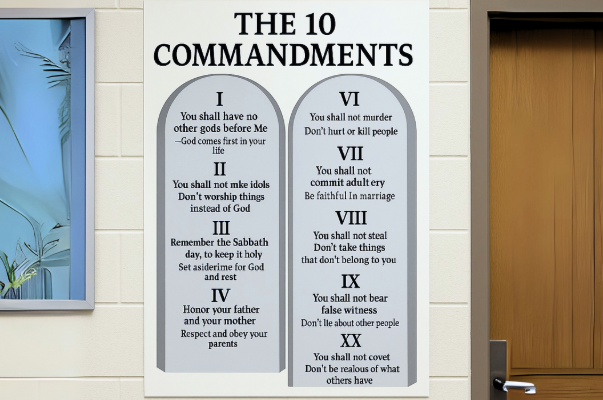
The poster will display the Ten Commandments using the same King James Bible language that’s on the monument outside the Texas State Capitol. Each poster must be at least 16 by 20 inches and can’t include any other text – just the commandments themselves in large, readable print.
Here’s what the Ten Commandments say (in kid-friendly language):
- You shall have no other gods before Me – God comes first in your life
- You shall not make idols – Don’t worship things instead of God
- You shall not take God’s name in vain – Use God’s name respectfully
- Remember the Sabbath day, to keep it holy – Set aside time for God and rest
- Honor your father and your mother – Respect and obey your parents
- You shall not murder – Don’t hurt or kill people
- You shall not commit adultery – Be faithful in marriage
- You shall not steal – Don’t take things that don’t belong to you
- You shall not bear false witness – Don’t lie about other people
- You shall not covet – Don’t be jealous of what others have
Picture this: text large enough for someone with average vision to read from anywhere in the classroom. That’s a pretty substantial presence in every learning space your child enters.
What’s interesting: While the first four commandments are specifically religious, commandments 5-10 are basic moral principles that most families teach at home regardless of their faith – respect your parents, don’t hurt people, don’t steal, don’t lie, don’t be jealous. And since the text doesn’t specify which god, families from different religious backgrounds might find some common ground here.
The Money Side That Affects Your District
Here’s something interesting: schools can accept private donations for these posters or use district funds to buy them. Community groups are already stepping up in places like Montgomery County to supply the posters, which means your property tax dollars might not have to cover this – but someone in your community is.
What This Means for You:
- As a Parent: Your child will see these displays daily, regardless of your family’s beliefs
- As a Taxpayer: Your district might use local funds, or community donations might cover the costs
- As a Community Member: Local groups are organizing around this – both supporting and opposing
What Psychology Research Actually Says
The research on religious displays in classrooms is more complex than you might expect. Recent studies from UTSA researchers found that religion can be “a mixed blessing for children as they get older”.
Some research shows religion linked to enhanced psychological adjustment and social competence among elementary school children, while other studies suggest religious education can help develop healthier reactions to stress and reinforce coping mechanisms.
The Reality: Religious and spiritual experiences have implications for many aspects of development, including cognitive, social-psychological, and emotional phenomena – but the impact varies dramatically based on how it’s presented and the child’s home environment.
The Legal Battle That Could Change Everything
Multiple lawsuits are already challenging this law. Parents from diverse faiths and civil liberties groups argue that mandatory religious displays violate the First Amendment, pointing to precedent from Stone v. Graham (1980), which struck down a similar Kentucky law.
The Bottom Line: Whether these posters stay up long-term depends entirely on how these court cases play out. Louisiana tried something similar and got blocked by the courts.
What Adults Who Grew up With This Actually Say
The key factors that seem to matter most:
- How teachers handle questions about the displays
- Whether diverse viewpoints are respected in classroom discussions
- The overall school culture around inclusion and respect
Your Family’s Reality Check
For Religious Families: This might align with your values, but you’ll want to talk with your kids about how different families believe different things.
For Non-Religious Families: Your children will see these displays daily. Consider how you want to discuss this at home and what conversations you might need to have.
For Families of Other Faiths: This represents one specific religious tradition. You’ll likely want to reinforce your own family’s beliefs and practices.
The Questions You’re Probably Asking
“Can my child opt out?” No – the law requires every classroom to conspicuously display these posters.
“What if my child asks questions?” Teachers will need to navigate these conversations carefully, balancing legal requirements with educational neutrality.
“How long will this last?” That depends on the ongoing court battles. Similar laws have been struck down before.
What Happens Next
This Fall: The law takes effect at the beginning of the 2025-26 school year, so expect to see these displays when school starts.
The Legal Front: Watch for court decisions that could either uphold the law or block it entirely.
In Your Community: Expect ongoing discussions at school board meetings, parent groups, and community forums about how this affects your local schools.
The Real Talk
Whether you support this law or oppose it, your child will encounter these displays every school day. The most important thing you can do is have age-appropriate conversations with your kids about different beliefs, respect for others, and how your family navigates questions about religion and values.
This isn’t just about posters – it’s about how we handle diversity, respect, and education in our communities. And those conversations are happening right now in every Texas town, from the biggest cities to the smallest rural districts.
Your voice matters in how your community handles this change. Stay informed, stay engaged, and keep talking with your kids about the values that matter most to your family.