
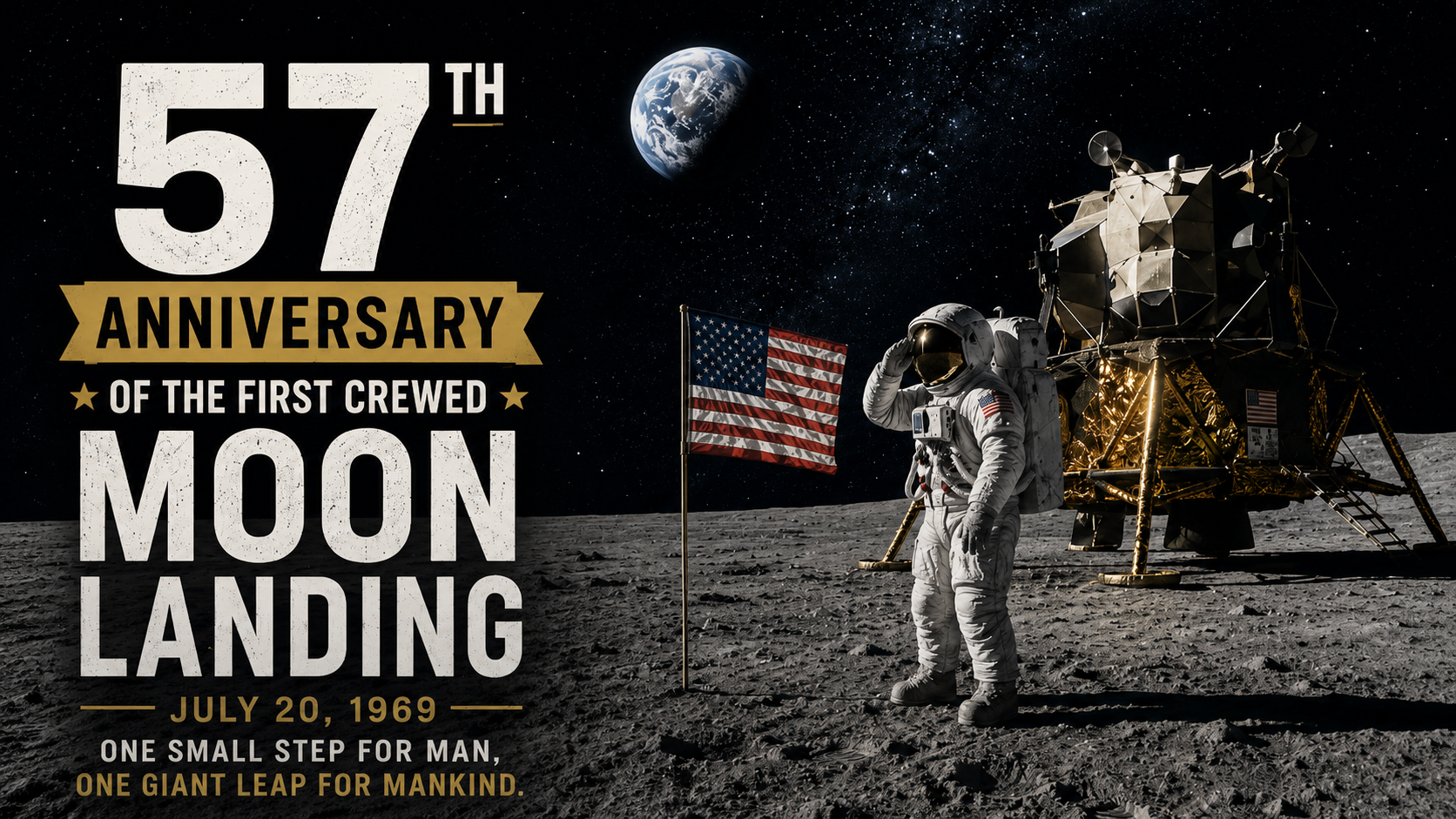
July 20 marks 57 years since Apollo 11 touched down — and no place on Earth has a deeper claim to that history than Texas, where the first words from the lunar surface were addressed to Mission Control in Houston
When Neil Armstrong radioed back from the surface of the Moon on July 20, 1969, the first word he spoke was the name of a Texas city. “Houston, Tranquility Base here. The Eagle has landed.” More than half a century later, that line still belongs to Texas — and every July, the state has a singular reason to look up.
July 20, 2026 marks the 57th anniversary of the first crewed Moon landing. Apollo 11 lifted off from Florida on July 16, 1969, carrying Neil Armstrong, Buzz Aldrin, and Michael Collins. Four days later, Armstrong and Aldrin guided the lunar module Eagle to the surface, and at 9:56 p.m. Houston time, Armstrong stepped down and spoke the words that have outlived everyone who first heard them: “That’s one small step for man, one giant leap for mankind.” The crew splashed down safely in the Pacific on July 24.
What many outside the state forget is how much of that mission ran through Texas. Mission Control operated out of the Manned Spacecraft Center — now NASA’s Johnson Space Center — in the Clear Lake area south of Houston. The flight controllers who guided the astronauts through descent, landing, and the long trip home worked around the clock in a control room on the Texas Gulf Coast. That is why the Moon heard a Houston address first.
Space Center Houston: The Front Door to Mission Control
For Texans who want to stand where the history happened, Space Center Houston is the place to start. The official visitor center for Johnson Space Center, it houses more than 400 space-flown artifacts, a full Saturn V rocket in climate-controlled Rocket Park, and authentic Apollo-era hardware. The centerpiece for anniversary visitors is the NASA Tram Tour, which carries guests onto the Johnson Space Center grounds to the restored Apollo Mission Control Center — preserved to look exactly as it did during the Apollo missions, down to the consoles, ashtrays, and coffee cups.
Standing in that room is as close as most people will ever get to the moment itself. The same space that guided Armstrong and Aldrin to Tranquility Base now greets visitors year-round, with the tram tour as the most popular draw. Tickets and timed entry can be reserved in advance at spacecenter.org, and booking the earliest slot is the best way to beat Houston’s summer crowds and heat.
See the Moon for Yourself: The George Observatory
The anniversary is also a fine excuse to do what the Apollo crews did — look at the Moon up close. About 90 minutes southwest of Houston, the George Observatory sits inside Brazos Bend State Park and opens its telescopes to the public on Stargazing Saturdays. Visitors line up at high-powered telescopes pointed at the craters of the Moon, the rings of Saturn, and the moons of Jupiter, guided by volunteers from the Houston Museum of Natural Science. It is a low-cost, family-friendly way to mark the anniversary under a genuinely dark Texas sky.
A Planetarium Trip Without Leaving the City
Closer in, the Burke Baker Planetarium at the Houston Museum of Natural Science in Hermann Park offers immersive dome shows that put the cosmos overhead — a good rainy-day or beat-the-heat alternative for families with younger kids. Between the planetarium, the museum’s broader collections, and the nearby Houston Zoo, it makes for an easy full day in the museum district.
North Texas: Space History in Dallas-Fort Worth
The anniversary reaches well beyond the Gulf Coast. In Dallas, the Frontiers of Flight Museum near Love Field traces the full arc of aviation and spaceflight — and its collection includes a space capsule and genuine Moon rocks, putting a piece of the lunar surface within reach of North Texas families. A few miles south, the Perot Museum of Nature and Science offers a dedicated space hall alongside its dinosaurs and earth-science floors, making it one of the most complete science-museum days in the state.
Over in Fort Worth, the Noble Planetarium at the Fort Worth Museum of Science and History keeps the dome-show tradition going with programs on the solar system and the night sky — a compact, affordable stop for families looking to turn the anniversary into a teaching moment.
San Antonio and the Hill Country: Look Up From the Alamo City
San Antonio holds its own piece of the story. The Scobee Education Center and Planetarium, named for Challenger commander and San Antonio native Dick Scobee, sits on the San Antonio College campus and runs affordable public planetarium shows — often for just a few dollars — that make the cosmos accessible to families and curious adults alike. For hands-on science, the Witte Museum on Broadway pairs Texas natural history with interactive labs, an easy anchor for a family day in the Alamo City. And on clear evenings, area astronomy groups host public viewing nights across the region, giving South Texans their own chance to put an eye to a telescope and find the Moon.
Why This Story Stays Texan
Anniversaries of the Moon landing come and go, and the big round-number celebrations — like the 50th in 2019 — draw the crowds and the concerts. But the 57th anniversary is a reminder that Texas does not need a milestone year to claim this history. The hardware is here. The restored control room is here. The institutional memory, carried forward now into NASA’s Artemis program and the push back toward the Moon, still runs through Johnson Space Center every single day.
So on July 20, whether you tour Mission Control, peer through a telescope at Brazos Bend, catch a planetarium show in San Antonio, or simply step into your own backyard and find the Moon in the Texas sky, you are part of a story that started — and in many ways still lives — right here. The Eagle landed a long time ago. In Texas, it never quite left.
Event Details
Apollo 11 Moon Landing Anniversary: Monday, July 20, 2026 (57th anniversary)
Space Center Houston: 1601 E. NASA Pkwy., Houston, TX 77058 — (281) 244-2100 — spacecenter.org — Open daily 10 a.m.–5 p.m. (weekends to 6 p.m.); NASA Tram Tours to the restored Apollo Mission Control Center included with admission, advance timed tickets recommended — Instagram and Facebook: @spacecenterhouston
NASA Johnson Space Center: 2101 E. NASA Pkwy., Houston, TX 77058 — public access is through Space Center Houston
George Observatory (Brazos Bend State Park): 21901 FM 762 Rd., Needville, TX 77461 — (281) 242-3055 — Open to the public Saturday evenings for Stargazing Saturdays; state park entry fee applies
Burke Baker Planetarium (Houston Museum of Natural Science): 5555 Hermann Park Dr., Houston, TX 77030 — (713) 639-4629 — Open daily 10 a.m.–5 p.m. — Instagram and Facebook: @hmns
Frontiers of Flight Museum: 6911 Lemmon Ave., Dallas, TX 75209 — (214) 350-3600 — Open Mon–Sat 10 a.m.–5 p.m., Sun 1–5 p.m. — Instagram: @frontiersofflight
Perot Museum of Nature and Science: 2201 N. Field St., Dallas, TX 75201 — (214) 428-5555 — Instagram and Facebook: @perotmuseum
Noble Planetarium (Fort Worth Museum of Science and History): 1600 Gendy St., Fort Worth, TX 76107 — (817) 255-9300 — Instagram and Facebook: @fwmsh
Scobee Education Center and Planetarium: 1198 San Pedro Ave., San Antonio, TX 78212 (San Antonio College) — (210) 486-0100 — tickets sold day-of, check schedule before visiting
Witte Museum: 3801 Broadway, San Antonio, TX 78209 — (210) 357-1900 — Instagram and Facebook: @wittemuseum