

The Edwards Aquifer Authority’s Education Outreach Center is open right now — and it won’t cost you a dime.
You drive over it every day, drink from it every morning, and probably don’t think about it much. The Edwards Aquifer is one of the most important natural resources in Texas, and there’s an entire education center in north San Antonio dedicated to helping you — and your kids — understand exactly why it matters. The best part: it’s completely free.
The EAA Education Outreach Center sits at 23400 Cibolo Vista, right on the EAA Recharge Zone on the grounds of Morgan’s Camp. It’s open Monday through Friday, 8 a.m. to 5 p.m., and you can schedule a visit in advance or just walk in.
Spring Is Buzzing at the EOC
The native plant garden is waking up — and it’s worth seeing right now. The Texas redbud tree is the first to bloom this season, drawing butterflies, honeybees, hoverflies, and native Texas bumblebees. You’ll likely hear them before you spot them. Their buzzing causes flowers to vibrate and release more pollen, making them some of the most efficient pollinators around.
Texas is home to over 700 species of native bees, and the EOC garden is designed to attract them. Rock roses, autumn sage, black foot daisies, and freshly planted wildflower seeds are all coming in — expect more color and more buzz as the season warms up.
Free Seed Packet — This Month Only
Show this article at the EOC front desk during March and walk away with a free seed packet. Start your own native garden at home and give local pollinators a place to land.
Mark Your Calendar: World Water Day — March 22
Every year on March 22, the world observes World Water Day, a tradition started by the United Nations in 1993. This year’s focus is water and gender. Women and girls around the world are disproportionately affected by the water crisis — often responsible for collecting water in communities without reliable access, which limits their time for school and work. The UN emphasizes that including women’s voices in water solutions is essential to making sure no one gets left behind.
It’s a global issue with local roots — and the Edwards Aquifer is a powerful reminder of why clean, accessible water matters right here in Texas.
What You’ll Actually See and Do
This is not a museum where you read placards and move on. Every exhibit is built to be touched, operated, and explored.
The Cloud Caster lets you create your own cloud of vapor that eventually turns into precipitation — showing exactly how rainfall fills the aquifer. The TopoBox is a fully interactive augmented reality tool where you can build different landforms with your hands, then trigger precipitation and watch rivers, lakes, and watersheds form in real time.
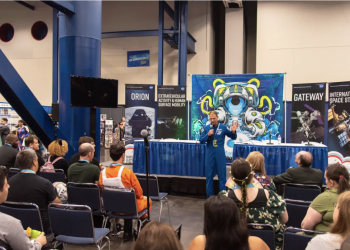
The Karst Theater is a 360-degree cave-like environment with boulder seating, multimedia presentations, and classroom experiences that put you inside the aquifer itself. The Global Perspective Display lets you watch weather patterns move across the globe from an astronaut’s point of view.
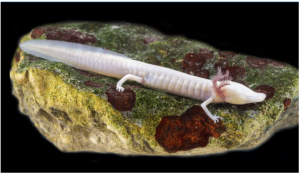
The Threatened and Endangered Species Aquarium brings you face to face with the Texas Blind Salamander and the Fountain Darter — two rarely seen endangered species protected under the Edwards Aquifer Habitat Conservation Plan. The Micro Eye exhibit lets you zoom in on the body structures of the Comal Springs Riffle Beetle, the Peck’s Cave Amphipod, the San Marcos Salamander, and more under the center’s microscope.
There’s also a Karst Touch Stone — a massive piece of Edwards Limestone formed 100 million years ago during the Mesozoic Era — and a Native Plant Demonstration Garden showing how drought-tolerant Texas plants can thrive even in dry times.
Mascot Spotlight: Meet the Texas Blind Salamander
This little creature carries a big responsibility. The Texas Blind Salamander is the EAA Education Outreach Center’s mascot — and it earns that title. Because it depends entirely on clean, stable groundwater to survive, it works like a frontline reporter for the health of the aquifer. When the salamander thrives, the water is clean. Scientists call that being an indicator species, and it makes this tiny, eyeless cave dweller one of the most important animals in Texas. You can see it up close in the Threatened and Endangered Species Aquarium.
Now Listening: The Recharge Zone Podcast
If you want to go deeper on all things Edwards Aquifer, the EAA has an official podcast called The Recharge Zone. Hosted by Ann-Margaret Gonzalez, Brent Doty, and Logan Schmidt, the show covers aquifer history, ecology, water science, and features guests from inside the EAA. Season 7 just kicked off on February 27. Find it on Spotify, Apple Podcasts, SoundCloud, or Amazon Music. Send episode ideas or questions to [email protected].
Perfect for Schools and Homeschool Groups
The center offers free field trip experiences designed specifically for schools and homeschool groups, with programs built to give educators a ready-made, curriculum-connected visit at no cost. Groups of 10 or more can book a customized group visit. School groups can also apply for bus transportation reimbursements — funding is limited, so apply early. Thanks to support from SAWS, H-E-B, and Laguna Water Supply, this program is available at no cost to educators.
Individuals and families can choose the self-guided visit option. Staff will walk you through the center, give you time to explore at your own pace, and point you toward the indoor and outdoor scavenger hunts.
Plan Your Visit
The EAA Education Outreach Center is ADA accessible, free, and open to everyone.
Location: 23400 Cibolo Vista, San Antonio, TX 78261 Hours: Monday through Friday, 8 a.m. to 5 p.m. Phone: (210) 547-2222 Email: [email protected] Website: eaaeoc.org Social: Facebook and Instagram @EAAEOC / @eaa_eoc