

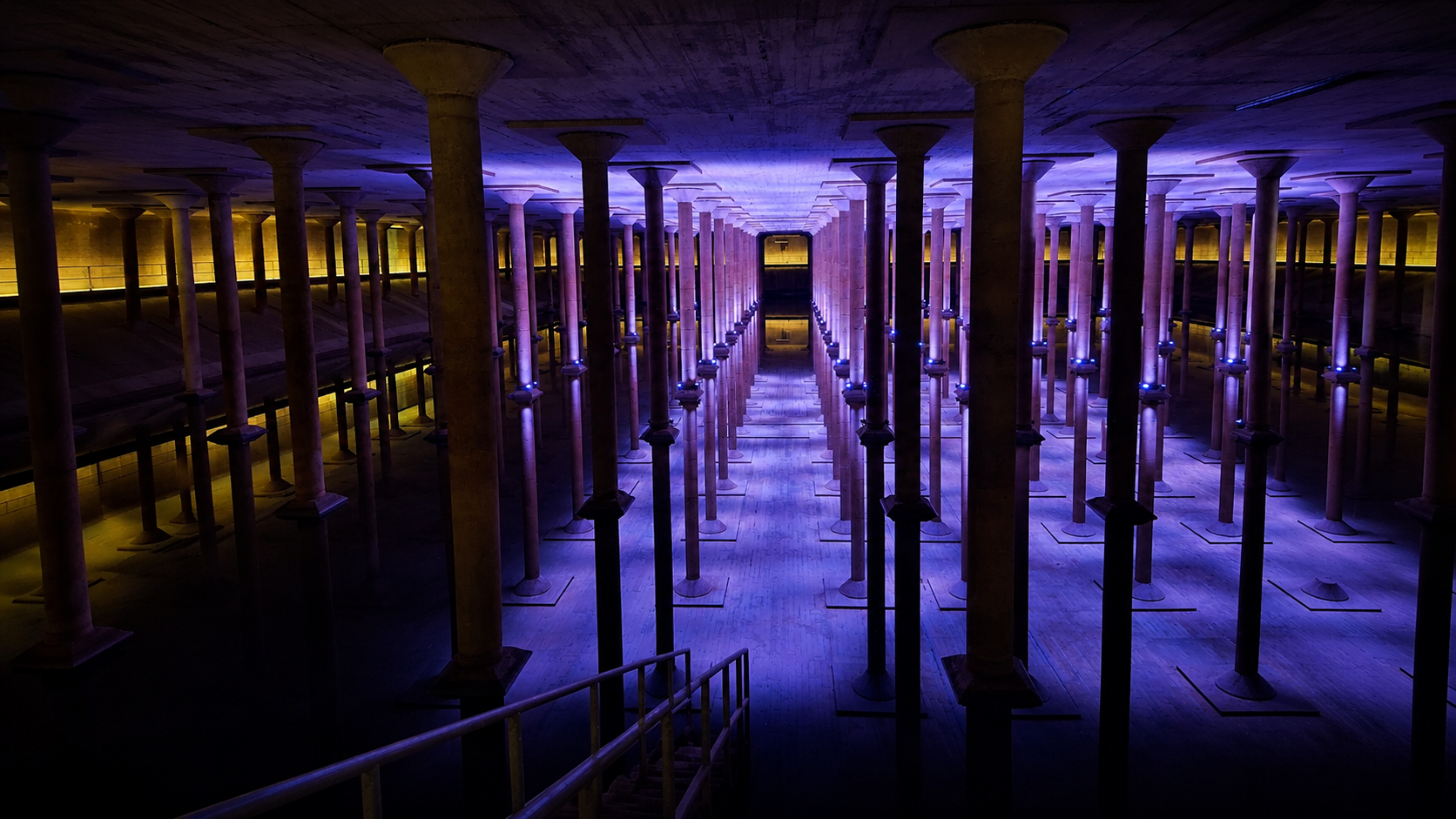
A 100-year-old underground reservoir the size of one and a half football fields, now home to guided history tours, a 17-second echo you can hear for yourself, and an immersive art installation that turns visitors’ voices into rivers of light — running through January 2027
Buffalo Bayou Park Cistern, 105 Sabine Street, Houston, TX 77007. Tours Wednesday through Sunday, 10 a.m. to 5 p.m., last entry 6:15 p.m. Reservations required. History tours $12–$15; Undercurrents art installation $12–$15. Free admission the first Thursday of every month. Ages 9 and up. Book at buffalobayou.org.
Well neighbor, if you’ve lived in Houston your whole life and never been down into the Buffalo Bayou Park Cistern — trust me on this one, it’s time. Just west of downtown, hidden beneath Buffalo Bayou Park, sits one of the most surprising and hauntingly beautiful public spaces in Texas: an 87,500-square-foot underground concrete reservoir built in 1926 to store Houston’s drinking water. It’s been quietly reborn over the past decade as a public tour space, art gallery, and performance venue like nothing else in the state. And right now, it’s home to one of the most talked-about interactive art installations in Houston’s recent history.
A century-old cathedral, rediscovered
Here’s the story, and it’s a good one. The Cistern was commissioned in 1926 as one of Houston’s earliest underground drinking water reservoirs, designed by engineer J.W. Turner and built to hold 15 million gallons of water for the growing city. For decades it did its quiet work. Then, in 2007, an irreparable leak led to the reservoir being decommissioned. It was very nearly demolished.
Instead — and this is the good part — Buffalo Bayou Partnership rediscovered the space in 2010 while developing Buffalo Bayou Park. Recognizing its architectural and historical significance, they hired the Houston-based firm Page to restore and reopen it as a public space. Additions like a ground-level passageway made it easy to enter, and today the Cistern welcomes visitors to walk directly into a piece of Houston history that most people don’t even know exists.
The scale of the room is what will hit you first. 87,500 square feet — the size of about one and a half football fields — held up by 221 slender, twenty-five-foot concrete columns arranged in perfect rows. It has been compared to the ancient Roman cisterns beneath Istanbul, and once you’re standing inside, you understand why. The air is cool and still. The lighting is dim and deliberate. And then somebody calls out from across the room and you hear it — the 17-second echo, one of the most remarkable acoustic effects you can experience in Texas. Speak, clap, whistle, sing. The sound rolls through the columns and comes back to you like a memory.
The History Tour — $15 (discounts available)
The standard way to experience the space is the guided History Tour. Docent-led, 30 minutes long, and priced at $15 per person, with $2 discounts for military, seniors 65 and up, college students, and youth ages 9 to 17. On the tour, you’ll learn about the Cistern’s construction, walk the perimeter path around the columns, hear the story of how it was found and saved, and get to test the 17-second echo for yourself. It’s genuinely one of the best-value tours in Houston.
Undercurrents — the current art installation, running through January 2027
Now here’s the reason to go right now. Since April 24, 2026, the Cistern has been home to an interactive art installation called Undercurrents, created by internationally acclaimed Mexican-Canadian artist Rafael Lozano-Hemmer. It runs through January 24, 2027 — so you have plenty of time to plan a visit, but you’d be foolish to wait.
Here’s how it works, and it’s magical. Along the perimeter of the Cistern, intercoms have been installed. You step up, push a button, and speak into the microphone. Your voice travels as pulses of white light along a mile-long network of LED strands strung between the 221 columns — a glowing nerve-like labyrinth that zigzags across the entire space and is doubled by the mirror-still layer of water on the floor. The Cistern then answers you. Using an algorithm, it identifies a related message from its collection and plays a response back, filling the chamber with more light and more voice.
The collection includes voice recordings from previous Lozano-Hemmer exhibits around the world — but the most striking additions are the voices of five Houston-based poets: Nick Flynn, Aris Kian, Martha Serpas, Jennifer Teets, and Roberto Tejada. Certain keywords trigger poetry readings recorded by the poets themselves, filling the space with soothing spoken word about nature, love, memory, and belonging. It is genuinely unlike anything else you’ll experience in Texas.
Tickets to the Undercurrents installation are $15 for general admission, $12 for seniors, military, and students. Ages 9 and up only. The installation is on view Wednesday through Sunday from 10 a.m. to 5 p.m.
Free First Thursdays
Here’s a tip worth knowing. Admission to the Cistern is free on the first Thursday of every month. If you’re on a budget, or if you just want to take the family, mark your calendar. Reservations are still required and slots fill up fast for free days, so book early.
A few things to know before you go
The Cistern is dim, quiet, and windowless. If small dark spaces make you uneasy, know that going in. Full participation on the standard tour involves walking about a quarter mile in 25 minutes — but if you’d prefer to stay put, just let the Cistern Attendant know when you check in, and they’ll set you up with a stationary or seated experience. The space is ADA compliant. No children under nine are allowed inside. Photography is allowed for personal use, but tripods and stands are not permitted except on designated photography tours. No eating, drinking, or gum chewing inside.
Reservations are required for every visit — walk-ups aren’t guaranteed a spot. Book through buffalobayou.org, and give yourself about 30 minutes for parking and check-in.
Parking and getting there
The Cistern is at 105 Sabine Street, right along Buffalo Bayou Park. Check in at The Water Works Visitor Center at 105-B Sabine Street. Limited free parking is available in The Water Works parking lot and along Sabine Street. If those spots are full, City of Houston Lot H has more than 400 spaces (pricing varies by day). Metered parking along Allen Parkway is available from 9 a.m. to 7 p.m. daily.
Make a day of it
Here’s a nice little tip. The Cistern is right in the middle of Buffalo Bayou Park — one of Houston’s most beautiful green spaces. After your tour, walk the trails, rent a kayak at Sabine Promenade, or grab a picnic under the trees. If you time your visit for late afternoon, you can stay for the Waugh Drive Bat Colony emergence at sunset just a short walk east along the bayou. It’s a full afternoon and evening’s worth of what makes Houston, well, Houston.
Why it’s worth going
Here’s the honest truth, neighbor. In a city known for space exploration, medical breakthroughs, and world-class dining, the Cistern is Houston’s best-kept secret hiding right underneath its own park. A hundred-year-old reservoir turned art cathedral, a 17-second echo you can play with, a light installation that responds to your voice, and free admission every first Thursday. This is the kind of experience that lingers — visitors describe it as haunting, meditative, and unforgettable. And it’s ten minutes from downtown.
So book a slot for this weekend or next. Show up early. Speak into the intercom, watch your voice become a river of light, and let a hundred years of Houston history echo back to you.
For tickets, tour options, private group bookings, and updates on programs like meditation sessions and poetry readings, visit buffalobayou.org.
See you underground, neighbor.