

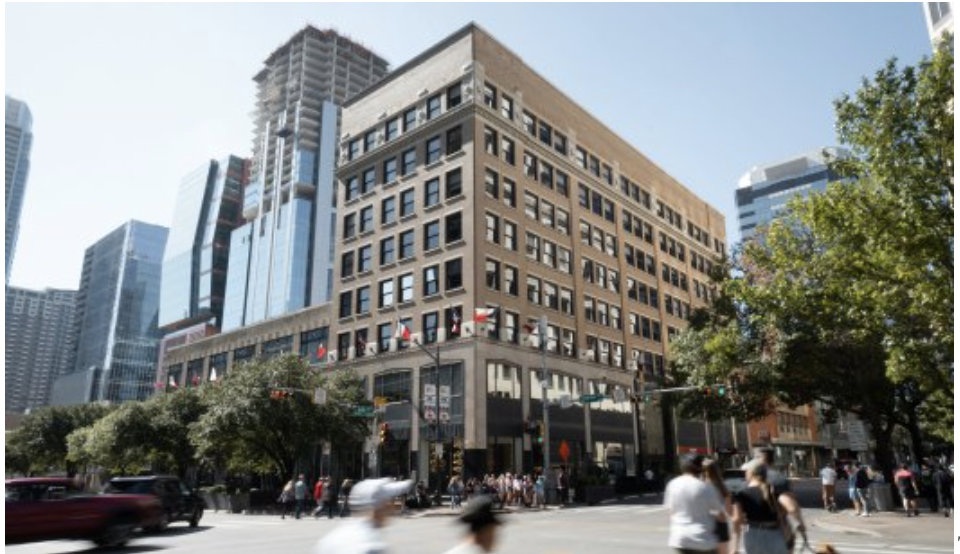
Austin’s newest university doesn’t look like traditional colleges. No massive quad, no legacy admissions, no DEI office pushing race-conscious policies. Instead, the University of Austin (UATX) occupies the historic Scarbrough Building on Congress Avenue, where students tackle Homer and Herodotus while building a radically different model for American higher education.
Founded in 2021 and opening its doors to the first undergraduate class in Fall 2024, UATX represents a direct challenge to what its founders see as ideological conformity and declining standards at elite institutions. The school’s statement of purpose pulls no punches: “The institutions that were meant to strengthen and improve our society — schools, universities, newsrooms, boardrooms — have instead become engines of confusion, cowardice, and ideological conformity.”
The Founders’ Vision
When venture capitalist Joe Lonsdale, St. John’s College president Pano Kanelos, historian Niall Ferguson, and journalist Bari Weiss met in Austin in May 2021, they shared concern about American higher education’s trajectory. Within months, they announced plans for a university dedicated to what they call “the fearless pursuit of truth.”
The timing proved fortuitous. By November 2023, UATX had raised $200 million from 2,600 donors and received over 6,000 faculty inquiries. Major donors including Harlan Crow and Bill Ackman backed the venture, with Bloomberg reporting that interest surged following elite universities’ responses to the 2023 Hamas attack on Israel.
Current president Carlos Carvalho, who spent 15 years at UT-Austin’s McCombs School of Business, leads the effort to build what UATX calls “the Navy SEALS of the mind” — a new leadership class driven by love of freedom, country, and truth over comfortable hedges.
Merit Above All Else
UATX admits students based almost entirely on test scores. On March 31, 2025, the university introduced automatic admission for applicants scoring at least 1460 on the SAT, 33 on the ACT, or 105 on the Classic Learning Test. No essays required, no legacy preferences, no racial considerations. Meet the threshold, pass an integrity check, and you’re in.
This merit-first approach eliminates the subjective admissions processes that have drawn lawsuits and Supreme Court scrutiny at other institutions. The Class of 2028 acceptance rate was 26% — selective, but transparent. Every admitted student knows exactly why they got in: they demonstrated academic capability through objective measures.
The reward? Full tuition scholarships worth $130,000 over four years. Both the inaugural Class of 2028 (approximately 100 students) and the Class of 2029 enrolling Fall 2025 receive complete tuition coverage, funded entirely by private donations. Students pay only for housing (estimated $16,500 annually), meals ($6,000), books ($1,200), and miscellaneous expenses — roughly $26,250 per year total.
This financial model represents a fundamental break from traditional universities increasingly dependent on federal student aid and massive endowments. UATX doesn’t currently qualify for federal aid because it hasn’t completed the accreditation process, but the scholarship model makes that irrelevant for early students willing to take a chance on something new.
The Great Books Reign Supreme
UATX’s curriculum centers on 15 core courses built around the Great Books canon. Students read Homer, Herodotus, Euclid, Confucius, the Bible, Tacitus, Machiavelli’s The Prince, Descartes, Burke, Tocqueville’s Democracy in America, George Eliot’s Middlemarch, Tolstoy’s War and Peace, Roger Scruton’s Beauty, and famous historical speeches.
This reading list stands in stark contrast to contemporary universities where, as critics note, undergraduates are more likely to encounter Maya Angelou than Alexis de Tocqueville. UATX argues that every American undergraduate should engage with Democracy in America to understand the nation’s political culture and democratic principles.
Director of Intellectual Foundations Jacob Howland oversees the program, which occupies students’ first two years. Junior and senior years allow specialization in interdisciplinary academic centers, while a four-year capstone project called the Polaris Project requires all students to “create or discover something serving the human good.”
Notable faculty include Michael Shellenberger (teaching on censorship and free speech), Coleman Hughes (examining the legacy of slavery), and Niall Ferguson (the historian who helped found the university). The small faculty ensures intensive attention — a luxury impossible at universities where professors manage hundreds of students.
Campus Life in Downtown Austin
Classes meet in the Scarbrough Building at 522 Congress Avenue, a historic 1910 structure that served as Austin’s first skyscraper and housed the city’s premier department store for decades. The building’s Art Deco renovations from 1931 created one of Austin’s most distinctive facades, combining limestone, black granite, geometric gold accents, and stained glass.
Students live in dormitories near the UT-Austin campus, giving them access to a vibrant college town atmosphere while attending a radically different institution. The downtown classroom location places students near Texas’s Capitol building, reinforcing the connection between education and civic life that UATX emphasizes.
The university plans to develop a residential campus in the greater Austin area and has begun master-planning, but for now, the urban campus model allows UATX to launch quickly while building toward a more traditional residential experience.
Free Speech as Foundation
The Austin Union, UATX’s student debate society modeled on Oxford Union, hosts regular debates open to the public. Students launched this organization even before arriving on campus, demonstrating the self-directed initiative UATX seeks in applicants.
The university’s constitution gives academic deans authority over student admissions — unusual in an era when admissions offices wield enormous power independent of faculty input. This structure ensures that those teaching students have direct say in who enters the classroom.
Executive Director of Admissions Stephen Asoli describes the Class of 2028 straightforwardly: “Every member is genuinely committed to the fearless pursuit of truth.” That commitment, he argues, provides the fundamental guarantee for free exchange of ideas.
The DEI Question
UATX’s approach to diversity, equity, and inclusion breaks completely with current university practice. The school’s DEI page contains no land acknowledgments, no equity statements, no diversity officers. Instead, it displays the Declaration of Independence.
This choice makes a philosophical statement: the Declaration’s assertion that “all men are created equal” and endowed with “unalienable Rights” represents UATX’s understanding of human dignity and equal treatment. No racial preferences, no identity-based admissions, no separate standards. Just merit, achievement, and the shared pursuit of truth.
Critics will call this approach inadequate or even hostile to diversity goals. UATX founders would respond that universities have abandoned genuine diversity — diversity of thought, perspective, and viewpoint — in favor of superficial demographic metrics while enforcing ideological conformity.
The Accreditation Process
UATX currently holds “candidate for accreditation” status from the Middle States Commission on Higher Education (MSCHE), granted August 28, 2025. This represents significant progress toward full accreditation, which typically takes several years for new institutions.
Until full accreditation arrives, UATX students cannot access federal student aid. The university compensates through full scholarships and is working to establish articulation agreements with other institutions so graduates can pursue graduate and professional programs without difficulty.
The Texas Higher Education Coordinating Board certified UATX to award Bachelor of Arts degrees in Liberal Studies in October 2023, providing state-level authorization even as federal accreditation proceeds. If accreditation is granted soon after the first class graduates, it may apply retroactively to include all students.
Notable Departures and Support
Not everyone who initially supported UATX remained on board. Robert Zimmer and Steven Pinker resigned from advisory roles in November 2021, saying the university’s statements about higher education diverged significantly from their views. More recently, Larry Summers resigned from the advisory board in July 2025, posting that he was “not comfortable with the course that UATX has set nor the messages it promulgates.”
These departures highlight tensions inherent in building a new institution explicitly positioned against mainstream academic culture. Some prominent academics support the critique of current universities but disagree with UATX’s specific approach or rhetoric.
Yet the university has also attracted significant support. Richard Dawkins joined the advisory board in July 2022. Major donors continue backing the venture, and faculty inquiries far exceed available positions. Students are voting with their applications — Fall 2025 admissions drew strong interest despite UATX’s newness and ongoing accreditation process.
What Success Looks Like
UATX measures success differently than traditional universities. No U.S. News rankings matter when you’re building from scratch. No peer institutions exist doing exactly what UATX attempts. The school defines success through questions about truth-seeking, intellectual rigor, student outcomes, and whether graduates develop the wisdom and leadership capacity to strengthen American institutions.
Students at UATX aren’t promised easy paths. They’re taking a risk on an unaccredited institution, forgoing federal aid, and committing to a demanding curriculum when they could attend established universities with recognizable names and extensive alumni networks.
But they’re also getting something unavailable elsewhere: a university that puts truth-seeking first, maintains rigorous intellectual standards, refuses to compromise merit for other goals, and teaches the great works of Western civilization without apology or qualification.
The practical Polaris Project ensures students don’t just read philosophy — they build, create, and contribute. This combination of classical liberal education and entrepreneurial action appeals to students frustrated by universities that seem more focused on ideology than learning.
The Bigger Picture
UATX represents one answer to a question troubling many Americans: Can higher education reform itself, or do we need completely new institutions?
For decades, critics have complained about grade inflation (Harvard giving nearly everyone A’s), declining academic rigor, ideological conformity, exploding costs, bloated administrations, and universities that seem more interested in activism than education. Various reform efforts have produced limited results.
UATX’s founders concluded that building new beats fixing broken. Rather than attempting to reform Harvard, Princeton, or Yale, they’re creating an alternative that demonstrates different possibilities.
If UATX succeeds — graduating students who become leaders, entrepreneurs, scholars, and citizens who strengthen American institutions — it validates the model and may inspire others to build similar alternatives. If it fails, critics will point to the difficulty of building viable institutions from scratch and argue for working within existing universities.
Either way, UATX forces a conversation about what universities should be, whom they should serve, and whether current practices serve those goals.
How to Learn More
UATX welcomes prospective students and their families to visit the Austin campus. Applications for Fall 2025 (Class of 2029) are now open, with full-tuition Founders Scholarships available for all admitted students.
The university’s website features extensive information about curriculum, faculty, admissions process, and the broader mission. Students, faculty, and supporters share regular updates through UATX’s Substack newsletter, which provides insight into daily campus life and intellectual culture.
For students scoring above the automatic admission thresholds, the decision is straightforward: apply, get admitted, and choose whether this bold educational experiment appeals more than traditional alternatives. For those below the thresholds, UATX evaluates based on test scores, AP/IB results, and up to three verifiable achievements.
The risk remains real — UATX is new, unproven, and swimming against powerful currents in American higher education. But for students who believe universities should pursue truth fearlessly, maintain high standards based on merit, and teach the great works that shaped Western civilization, UATX offers something increasingly rare: a university that takes those commitments seriously.
University of Austin Details:
- Location: 522 Congress Ave, Suite 300, Austin, TX 78701 (Scarbrough Building)
- Founded: 2021
- First Class: Fall 2024 (Class of 2028, ~100 students)
- Automatic Admission: SAT 1460+, ACT 33+, or CLT 105+
- Tuition: Full scholarships for Classes of 2028 and 2029 ($130,000 value over four years)
- Curriculum: 15 Great Books core courses, interdisciplinary centers for upperclassmen
- Accreditation Status: Candidate for accreditation with Middle States Commission on Higher Education
- President: Carlos Carvalho
- Founders: Joe Lonsdale, Pano Kanelos, Niall Ferguson, Bari Weiss
- Funding: $200 million raised from 2,600 donors
- Website: uaustin.org
- Federal Tax ID: 87-1925354 (501(c)(3) charitable organization)