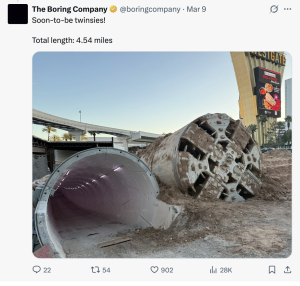

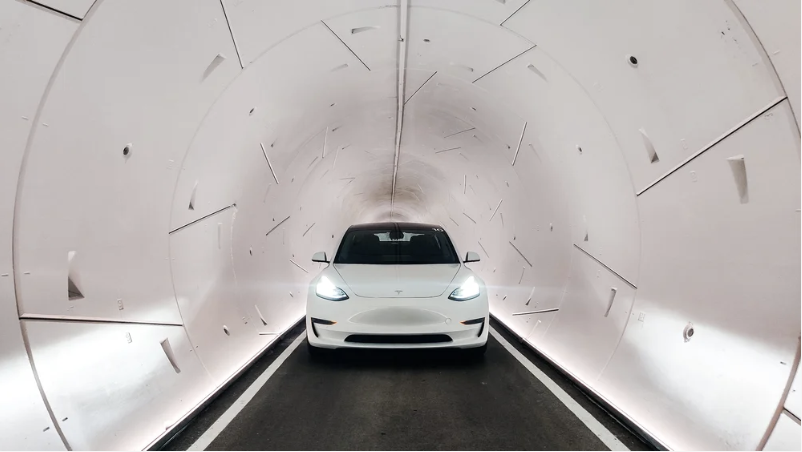
Texas is Elon Musk’s testing ground for the future of underground transportation — and some of it is already being built beneath your feet.
Texas makes sense as the launch pad for Musk’s Boring Company vision of “3D cities” — roads running above and below ground simultaneously. Land is cheap, regulations are lighter, and Musk already operates Tesla, SpaceX, and X here. Add the explosive growth of Austin, Dallas, and Houston, and you have the perfect proving ground. The question is what’s real, what’s coming, and what’s still a sketch on a napkin.
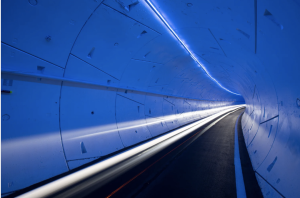
Two tunnels are already running. The Cybertunnel beneath the Tesla Gigafactory in Austin moves Cybertrucks under a highway, cutting a 12-minute surface drive to roughly 60 seconds. Outside Bastrop, east of Austin, a test track is actively running trials on high-speed transport pods. No passengers yet — but the technology is being developed in real time.
The most realistic near-term project is smaller than you’d expect. A pedestrian and trail tunnel in Bastrop — under half a mile, estimated at $5 to $7 million — would connect walking and biking paths and could be completed within a year of approval. Dallas entered the picture in 2026 with a one-mile tunnel proposal for the University Hills development, notable because it could cost the city nothing. Private funding would cover the tab. Early stage, but worth watching.
Houston has the highest stakes. A proposed 36-mile tunnel system would run from reservoirs to the Port of Houston, designed specifically for flood control in a city that knows exactly what Harvey cost. The Boring Company’s estimated price: around $760 million. The problem: no funding, no approval, and engineers have questioned whether the tunnels would be large enough to handle a major flood event. If it clears every hurdle, expect a 10-to-15-year buildout.
The big network connecting Austin to San Antonio — with stops in Kyle, San Marcos, and New Braunfels — remains conceptual. No funding, no construction, no confirmed timeline. San Antonio’s airport-to-downtown tunnel proposal, modeled on Boring Company’s Las Vegas system, was floated and stalled. A South Texas concept linking South Padre Island to the SpaceX site at Boca Chica exists only in early discussion.
On timeline, skepticism is warranted. The Boring Company moves faster than traditional tunneling operations, but small projects still take six months to a year and a half after approval. City-scale tunnels run two to five years. Regional systems are decade-long undertakings — and a significant number of Boring Company proposals nationwide have been announced without ever breaking ground.
The bottom line for Texans: short tunnels under parks, campuses, and private developments are coming first. Dallas and Bastrop are the most likely near-term additions. Houston’s flood tunnel is the project with the most potential impact, and the most uncertainty. Everything connecting cities at speed remains, for now, a vision.
Texas is Musk’s underground laboratory. The experiment is just getting started.
The Boring Company in Texas — Project Status
Operational: Cybertunnel at Giga Texas (Austin); Bastrop high-speed test track.
Under discussion: Bastrop pedestrian and trail tunnels; Dallas University Hills tunnel; Houston 36-mile flood control system; Austin–San Antonio regional transit network.